
Riding across state lines means dealing with different insurance rules, liability limits, and coverage requirements. What works in one state might leave you exposed in another.
At Leslie Kay’s, Inc., we help riders understand how to protect themselves with ATV insurance across states. This guide breaks down what you need to know before your next multi-state adventure.
Why State Rules Matter for Your ATV
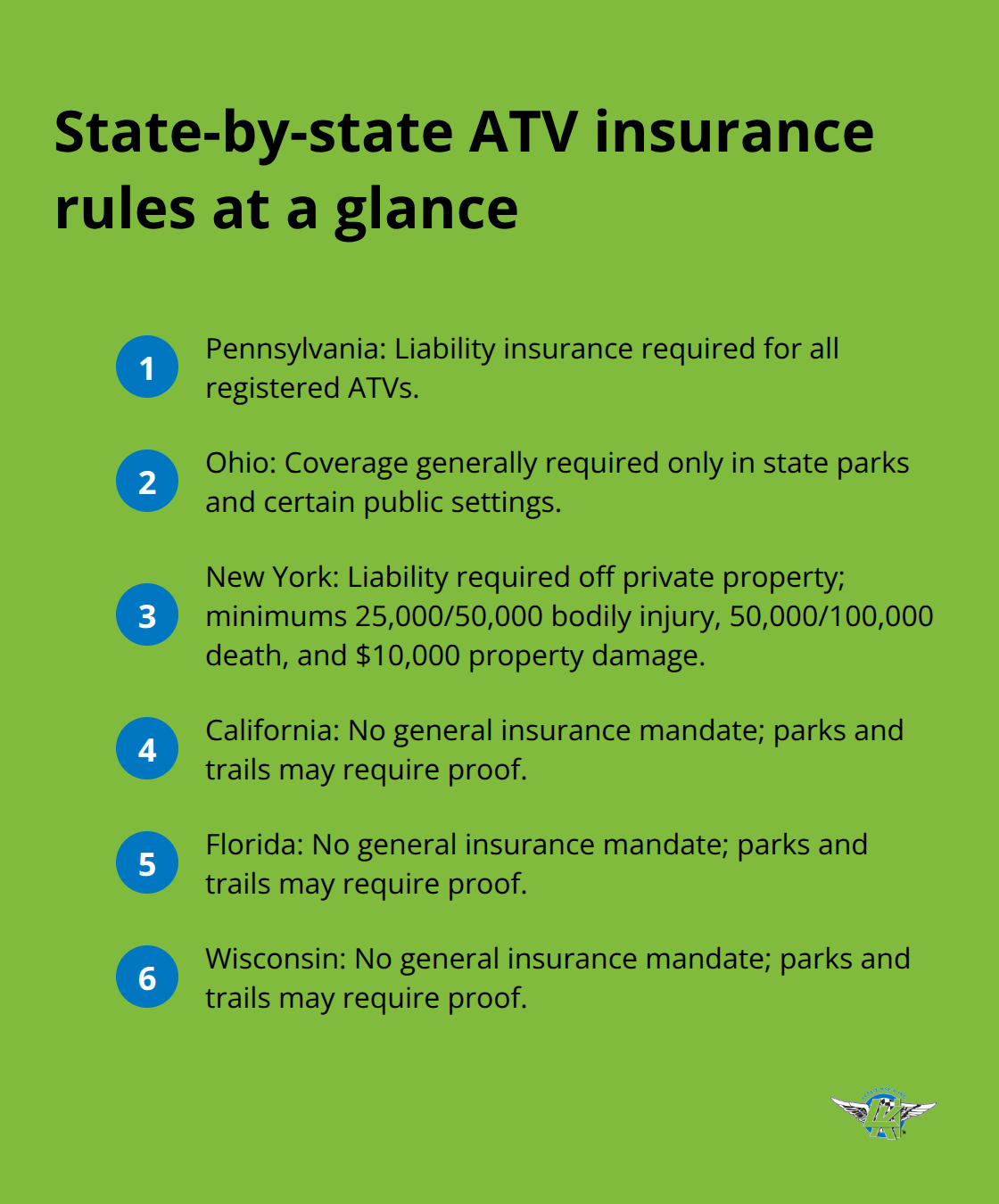
Each state treats ATV insurance differently, and these differences create real financial exposure if you’re not prepared. Pennsylvania requires liability insurance for all registered ATVs, while Ohio only mandates coverage in state parks and certain public settings. New York goes further, requiring liability coverage off private property with minimums of 25,000/50,000 for bodily injury, 50,000/100,000 for death, and 10,000 for property damage. Meanwhile, California, Florida, and Wisconsin have no general insurance mandates at all, though individual parks and trails can still demand proof of coverage before entry.
The gap between states matters because riding uninsured in a state that requires coverage exposes you to fines, registration suspension, and personal liability for accidents. A serious ATV incident generates medical bills exceeding $200,000, and with property damage and legal fees combined, costs can reach half a million-far beyond what your personal finances can absorb.
Public Land Riding Carries Stricter Requirements
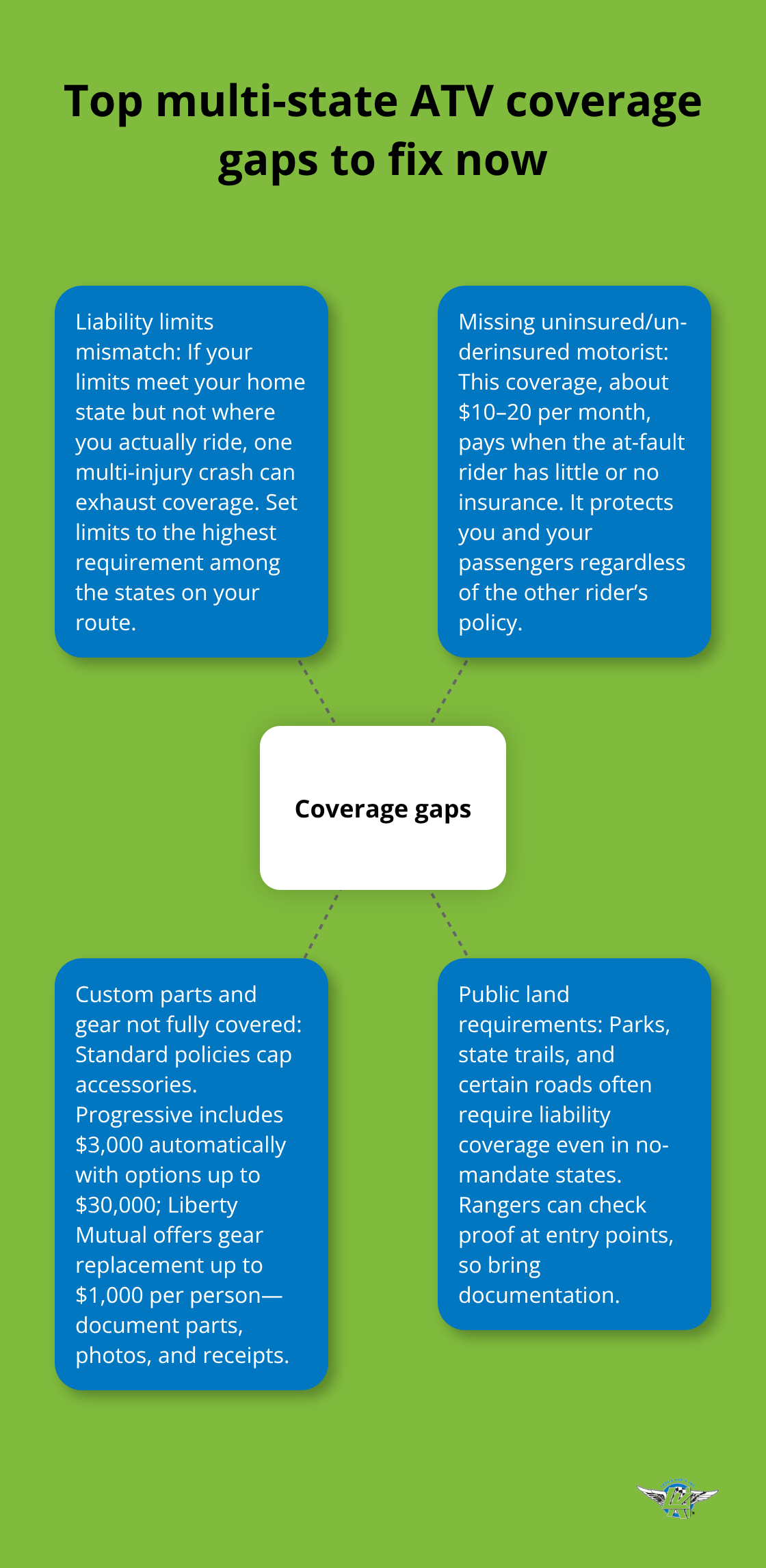
Public land riding carries the strictest requirements because states view it as higher-risk activity. If you cross county or township roadways, use state park trails, or ride on authorized paved roads, most states demand liability coverage regardless of their general ATV rules. Park rangers may check for proof of coverage at entry points, so you cannot assume that private-property exemptions apply once you leave your land. Many states also enforce minimum liability insurance at specific parks and trail systems, so you must check local rules before you ride rather than guess.
Private Property Creates a Coverage Gap
Private property riding sits in a gray zone that catches many riders off guard. While state law may not require insurance, your homeowners policy almost certainly excludes ATV accidents, leaving you personally liable for injuries or damage. This distinction matters enormously because many riders assume their home insurance covers off-property incidents-it does not. If a guest suffers a serious injury on your ATV while riding on your property, your homeowners coverage will deny the claim, and you face the full cost of medical treatment and potential lawsuits.
Financed ATVs Force the Insurance Issue
If you finance or lease an ATV, your lender will require comprehensive and collision coverage as a loan condition, which forces the insurance issue regardless of state law. Lenders protect their investment by mandating these coverages, so you cannot avoid the requirement by claiming your state does not require it. This requirement actually works in your favor because it ensures you carry protection that covers your own vehicle, not just liability to others.
Verify Requirements Before You Ride
Before riding in a new state, contact your state’s DMV or speak with an independent agency that specializes in multi-state ATV coverage and understands how these rules interact with your specific riding patterns. State rules change throughout the year, so what applied last season may not apply now. Understanding these variations sets the stage for selecting the right coverage options across your riding territory.
Getting ATV Coverage Across Multiple States
Map Your Riding Territory First
Start by mapping exactly where you ride and how often you cross state lines. This matters because your coverage needs depend entirely on your actual travel patterns, not hypothetical scenarios. If you ride primarily in Pennsylvania but take an annual trip to New York, your liability minimums must satisfy both states’ requirements-which means meeting New York’s stricter 25,000/50,000 bodily injury standard rather than Pennsylvania’s lower threshold. Document your routes for the next twelve months: which states you enter, which public trails and parks you access, and whether you cross county roadways. This inventory prevents you from buying insufficient coverage or overpaying for protection you don’t need.
Many riders assume they need uniform limits everywhere, but that approach wastes money. Instead, your policy should meet the highest minimum in any state where you ride regularly. If you venture into just one high-requirement state annually, raise your limits to that state’s standard rather than maintaining lower coverage year-round.
Find Insurers Who Cover Your Routes
Finding an insurer who actually covers multiple states separates practical riders from those left stranded mid-adventure. Progressive, Liberty Mutual, and GEICO all advertise multi-state ATV coverage, but availability varies by location and vehicle type. When you contact insurers, ask directly whether your coverage remains active if you ride in neighboring states, whether your liability limits automatically adjust to meet higher state requirements, and what documentation you need at trail checkpoints.
Confirm that any discounts-safety course completion, bundling, paying annually-apply across all states where you ride, because some carriers limit discounts to your home state only. Request a quote that explicitly lists which states are covered and at what liability limits, then compare that against your route map. An insurer that covers forty-eight states means nothing if your favorite trail system sits in state forty-nine.
Compare Quotes Beyond the Premium
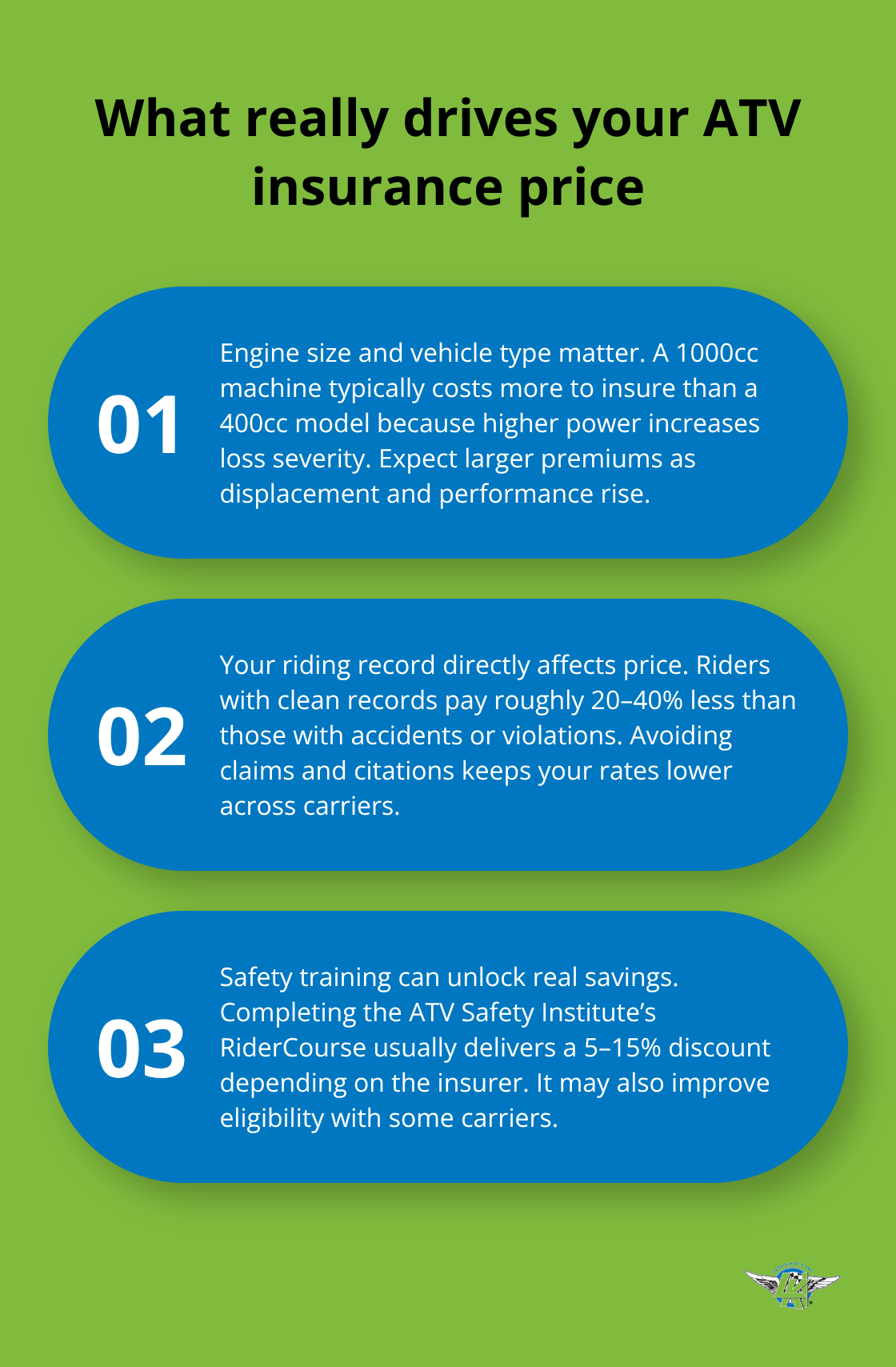
Pricing varies dramatically based on your ATV’s engine size, your riding history, and whether you carry passengers. A 1000cc machine costs more to insure than a 400cc model, and riders with clean records pay roughly 20-40% less than those with accidents or violations. Completed safety training through the ATV Safety Institute’s RiderCourse typically unlocks a meaningful discount across carriers-usually 5-15% depending on the insurer.
When you compare quotes, don’t focus on the lowest annual premium alone. A $1,200 policy with a $250 collision deductible and full accessory coverage protects you differently than an $800 policy with a $1,000 deductible and a $2,000 limit on custom parts. Evaluate total out-of-pocket exposure in a real accident scenario, not just the premium number. This comparison reveals which policy actually protects your investment and your finances when you need it most, which leads directly to identifying coverage gaps that most riders overlook.
Common Coverage Gaps and How to Avoid Them
Most riders discover their coverage problems only after an accident, when they learn that their liability limits don’t cover the damage, their accessories aren’t protected, or they’re facing medical bills their policy won’t touch. These gaps are entirely preventable with the right strategy.
Liability Limits That Fall Short Across State Lines
The first gap emerges when riders carry liability limits that satisfy their home state but fall short in neighboring states where they actually ride. New York’s 25,000/50,000 bodily injury minimum looks reasonable until you compare it to states like Pennsylvania or Ohio with lower thresholds. Here’s the problem: if you’re underinsured relative to where you actually ride, a single accident with multiple injured riders can exhaust your coverage and leave you personally liable.
The U.S. Consumer Product Safety Commission reports ATVs generate over 100,000 emergency room visits annually, and serious incidents regularly produce medical bills exceeding $200,000. Your liability limits must reflect the highest requirement across every state in your actual riding territory, not just your home state. If you ride in five states, identify which one has the strictest standard and set your coverage to that level across all five. This single decision eliminates the most common gap that leaves riders exposed.
Uninsured Motorist Protection You’re Likely Missing
The second gap involves uninsured and underinsured motorist protection, which most riders skip because they assume other riders carry insurance. They don’t. If another ATV rider hits you and carries minimal or no coverage, your medical payments coverage won’t activate, and you’re left absorbing treatment costs yourself unless you carry uninsured motorist protection.
This coverage costs roughly $10-20 monthly but covers you and your passengers regardless of the other rider’s insurance status. The protection activates when another rider causes an accident but lacks sufficient insurance to pay your claims. Without it, you face the full financial burden of injuries that someone else caused.
Custom Parts and Accessories Require Specific Documentation
The third gap is custom parts and accessories, which standard policies cover only partially. Progressive includes $3,000 in automatic upgrade coverage with options to purchase up to $30,000 additional protection, while Liberty Mutual offers gear replacement up to $1,000 per person per incident for safety equipment. If you’ve invested $5,000 in aftermarket modifications or high-end riding gear, confirm your policy covers that specific dollar amount before an accident forces you to absorb the loss.
Documentation determines whether the insurer replaces your gear at actual cost or argues the value down. Photograph your ATV with all accessories, list serial numbers for custom parts, keep receipts for modifications, and maintain this inventory digitally and in print. When you file a claim, this proof shows exactly what you owned and what it cost. Without it, you’ll settle for far less than you invested.
Final Thoughts
Your liability limits must meet the highest standard across every state where you actually ride, not just your home state. New York’s 25,000/50,000 bodily injury minimum becomes your baseline if you ride there annually, even if Pennsylvania or Ohio allow lower coverage. Documenting your riding territory, confirming multi-state coverage with your insurer, and protecting custom parts through proper documentation prevents the gaps that catch most riders off guard after an accident.
An experienced agency understands how ATV insurance across states interacts with your specific routes and riding patterns. An independent agent who specializes in multi-state coverage shops multiple carriers simultaneously, identifies which policies actually cover your territory, and catches gaps that online quotes miss. They verify that your discounts apply across all states, confirm your liability limits satisfy each jurisdiction’s requirements, and ensure your accessories are protected at their actual replacement cost.
Contact Leslie Kay’s, Inc. to get a quote that covers your multi-state riding territory and locks in the protection you actually need. We shop multiple carriers to deliver customized policies that protect your ATV across the states where you ride and handle claims support when accidents happen. Our team offers seven-day-a-week service so you’re never stranded without answers.
The information provided in this blog is for general informational purposes only and does not constitute legal, financial, or insurance advice. Coverage options, terms, and availability may vary. Please consult with a licensed professional for advice specific to your situation.
Artificial intelligence may have been used to generate text and images in some blog articles.