
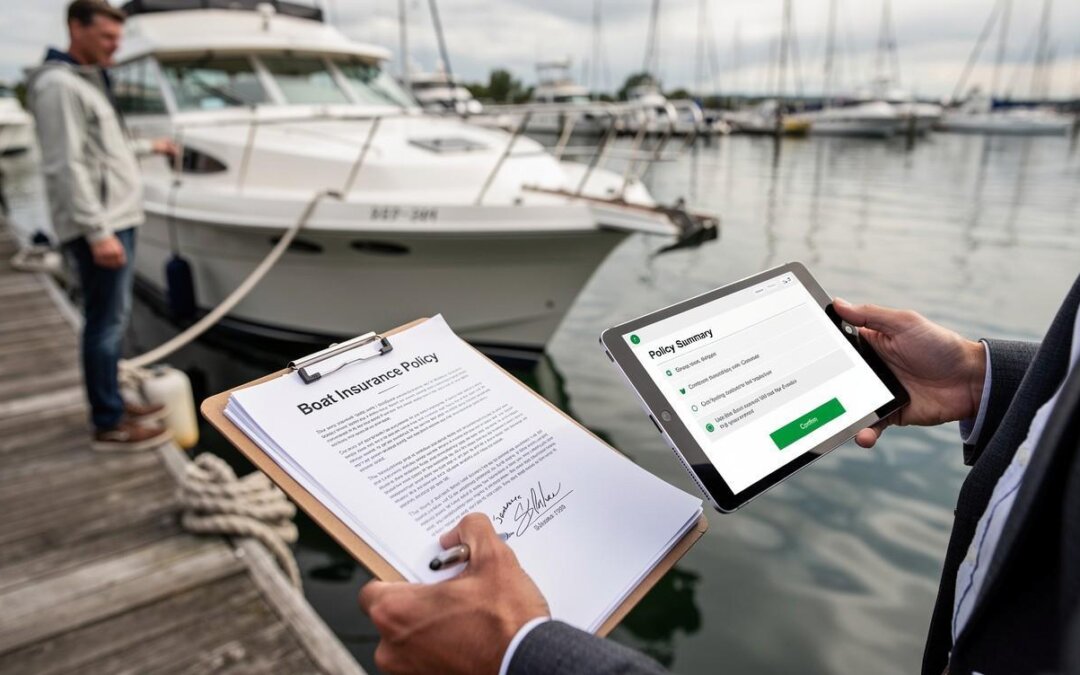
Boat policy ownership is one of the most overlooked aspects of watercraft management, yet it’s essential for protecting your investment and staying compliant with the law.
At Leslie Kay’s, Inc., we’ve helped countless boat owners navigate their insurance options and find coverage that actually fits their needs. This guide walks you through everything you need to know about boat insurance, from legal requirements to cost-saving strategies.
Why Boat Insurance Matters More Than You Think
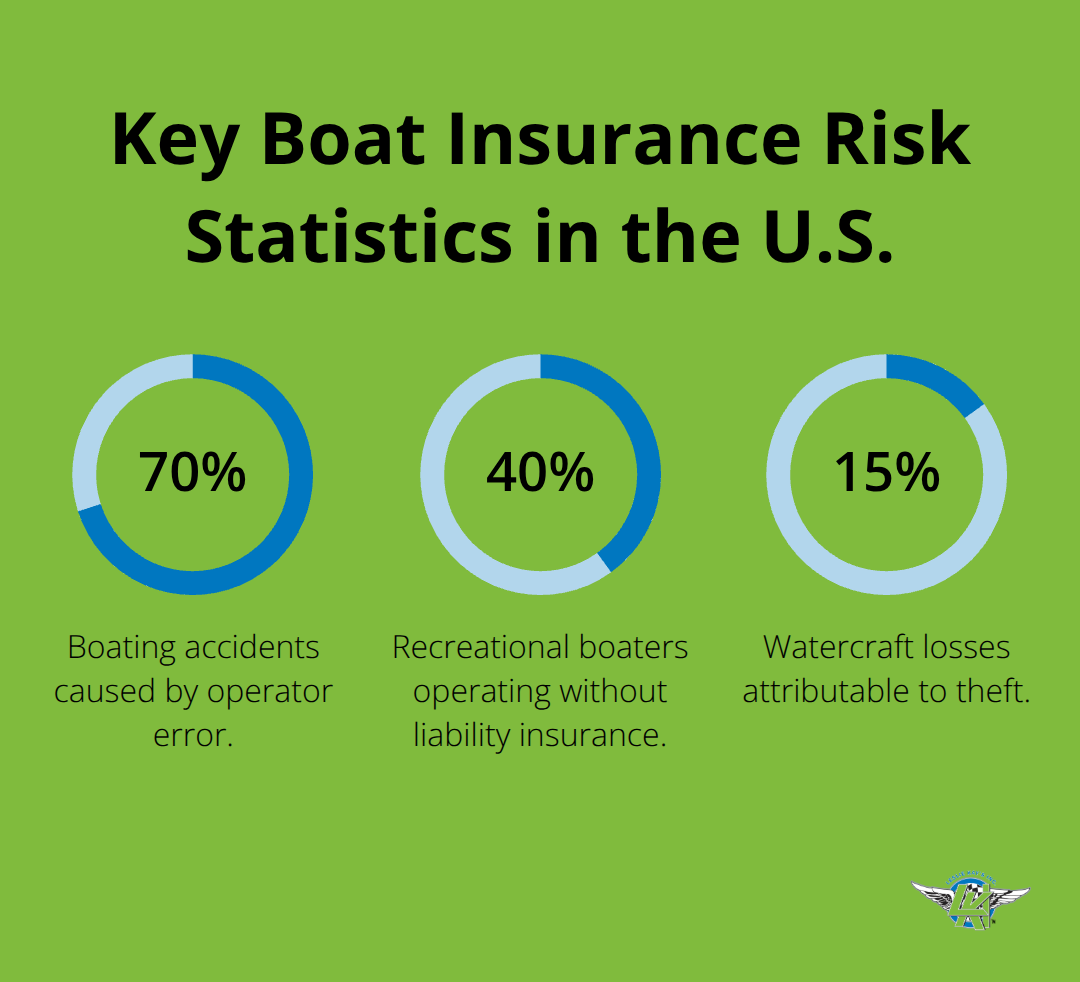
Most boat owners learn the hard way that homeowners insurance won’t cover watercraft damage or liability. Boat insurance is a separate policy that protects your vessel, your finances, and anyone injured while using your boat. In most states, if you finance your boat, the lender requires liability coverage before you take possession. Even if you own your boat outright, skipping insurance exposes you to catastrophic financial risk. A single accident involving another boat or swimmer can cost $50,000 to $500,000 in medical bills and property damage. The U.S. Coast Guard reports that operator error causes approximately 70 percent of boating accidents, and those accidents often result in lawsuits that drain personal assets without proper coverage.
Many boat owners underestimate their exposure, thinking a small speedboat or fishing vessel requires minimal protection. That assumption is wrong. Your boat’s value, the water conditions where you operate it, and the number of people aboard all factor into your actual risk. Liability coverage is non-negotiable because it protects your home, savings, and future income if someone sues after an injury on your boat.
State Laws Require Minimum Coverage
Every coastal state and most inland states mandate liability insurance for boat operation. The minimum limits vary widely-some states require as little as $15,000 in bodily injury coverage, while others demand $100,000 or more. Florida requires $15,000 in liability coverage for boats over 10 horsepower, but that amount falls short of real injury costs. California and Texas impose stricter minimums and additional regulations based on boat size and type. Violating these requirements results in fines ranging from $250 to $5,000, plus suspension of boating privileges.
Coverage Types That Protect Your Investment
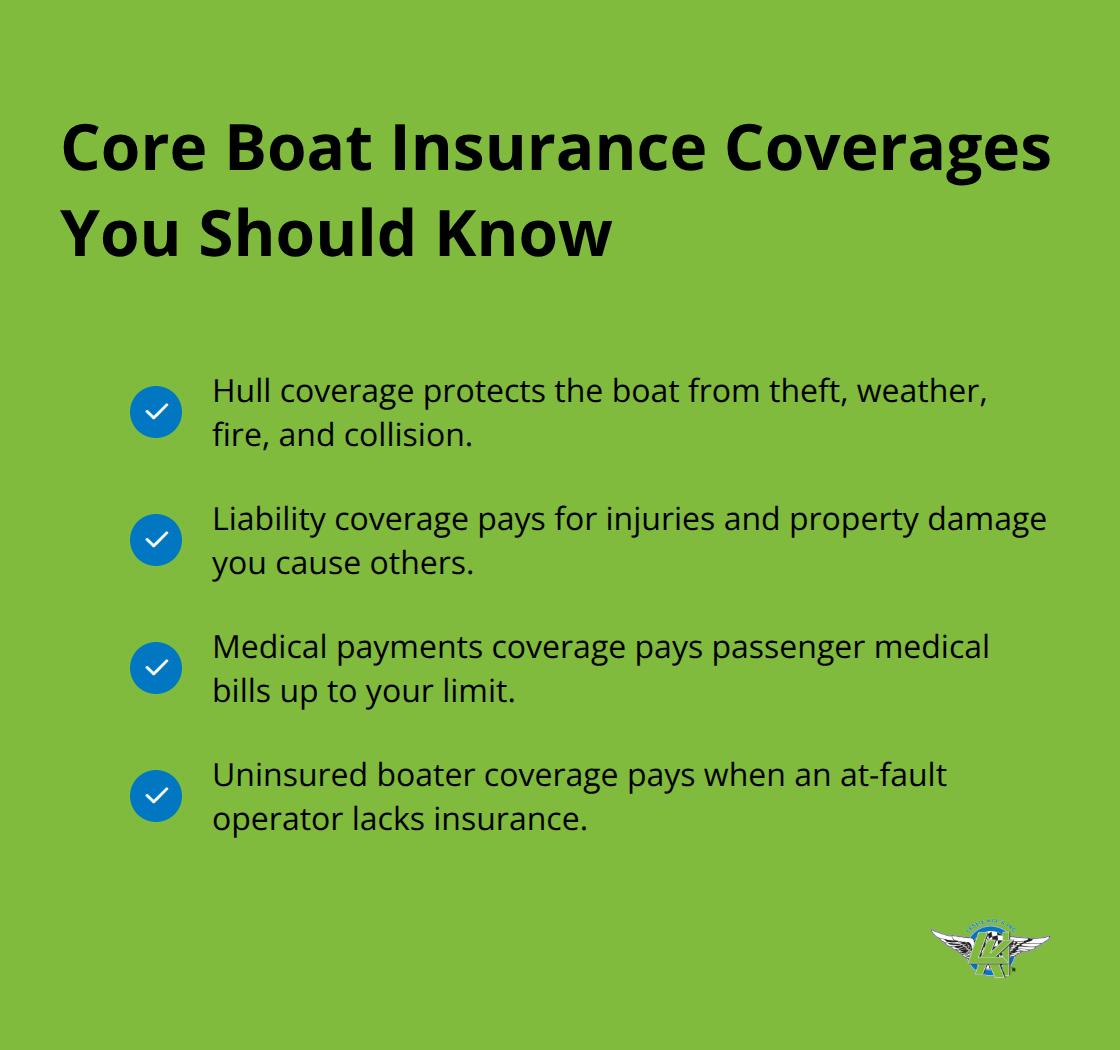
Hull coverage protects your actual boat from theft, weather damage, and collision-something most lenders require as well. Medical payments coverage handles hospital bills for injured passengers up to your policy limit, typically $1,000 to $10,000 per person. Uninsured boater coverage protects you if another operator hits your boat and lacks insurance themselves (a scenario that happens more often than most people realize).
Understanding these coverage types matters because each one addresses a different financial exposure. Your liability limits, hull deductible, and medical payments ceiling all work together to create your complete protection. The right combination depends on where you boat, how often you operate your vessel, and what assets you need to shield from lawsuits.
What Each Boat Insurance Coverage Type Actually Protects
Hull coverage, liability protection, medical payments, and uninsured boater coverage form the backbone of a complete boat insurance policy, but most owners misunderstand what each one covers and how much protection they actually need. The difference between adequate coverage and underfunded limits often comes down to tens of thousands of dollars when a claim arrives. Understanding these distinctions helps you build a policy that matches your actual risk.
Hull Coverage Pays for Your Boat, Not Just Collisions
Hull coverage protects the physical structure of your vessel from theft, weather damage, fire, and collision. The National Association of Insurance Commissioners reports that theft accounts for approximately 15 percent of watercraft losses, making this coverage non-negotiable if you moor your boat in a public marina or leave it unattended. Your deductible directly affects your premium-choosing a $1,000 deductible instead of $500 can reduce your annual cost by 15 to 25 percent, depending on your boat’s value and age.
Boat owners with vessels worth less than $15,000 should select higher deductibles to keep premiums reasonable, while those with expensive cruisers or performance boats should maintain lower deductibles to protect their investment. Hull coverage includes the engine, electronics, and permanently installed equipment, so your fish finder, GPS system, and marine radio receive protection under this section. Your boat’s age matters significantly-vessels over 15 years old typically cost 30 to 40 percent more to insure because repair expenses climb and replacement parts become harder to source.
Liability Coverage Shields Your Personal Assets from Lawsuits
Liability coverage pays medical bills and property damage when you cause injury or damage to someone else’s boat, dock, or body. A single serious injury claim can easily exceed $250,000 in medical costs, and many policies limit liability to $100,000 or $300,000-amounts that fall dangerously short of actual damages. The Insurance Information Institute notes that boating accident lawsuits increasingly target boat owners’ personal assets when policy limits run dry, meaning your home and savings become vulnerable without sufficient coverage.
Boat owners should carry minimum liability limits of $300,000 per occurrence, and $500,000 is far more prudent if you operate frequently in crowded waters or host multiple passengers. Jet skis and speedboats require higher limits than sailboats because they pose greater injury risk, and your insurance carrier will adjust your premium accordingly. Liability coverage works alongside medical payments and uninsured boater protection to create layered defense-liability pays when you’re at fault, while medical payments and uninsured boater coverage protect you when the other party lacks insurance or you’re not responsible for the accident.
Uninsured Boater Coverage Handles Accidents with Uninsured Operators
Uninsured boater coverage protects your boat and passengers when an operator without insurance hits you or causes injury. The U.S. Coast Guard estimates that approximately 40 percent of recreational boaters operate without liability insurance, making this coverage essential rather than optional. This protection covers both physical damage to your hull and medical expenses for injured passengers when an at-fault uninsured operator causes the accident.
Medical payments coverage operates independently and pays hospital bills for injured passengers regardless of fault, typically offering $1,000 to $10,000 per person per accident. Try setting medical payments coverage at $5,000 minimum if you regularly carry passengers, since a single water sports injury can generate $8,000 to $15,000 in emergency room and follow-up treatment costs. Choosing the right combination of these coverages requires honest assessment of where you boat, how many people ride with you, and what financial exposure you can realistically handle if something goes wrong-factors that directly influence your premium and your protection level.
What Really Drives Your Boat Insurance Premium
Your boat’s age, type, and value form the foundation of your premium calculation, but insurance carriers weight these factors differently than most owners expect. A 12-year-old center console fishing boat worth $35,000 costs substantially more to insure than a brand-new sailboat valued at $40,000, simply because repair costs and claims frequency differ dramatically between vessel types. Fiberglass speedboats generate higher claims for collision damage than aluminum jon boats, and this reality shows up immediately in your quote.
Boat Characteristics That Spike Your Costs
Vessels over 15 years old experience higher claim rates for mechanical failures and weather damage, which insurers price into their premiums accordingly. Your boat’s horsepower also matters-anything over 200 horsepower triggers premium increases of 25 to 35 percent because high-performance vessels attract operators with riskier behavior patterns. Location compounds these factors significantly. A boat moored in Miami costs 50 to 70 percent more to insure than an identical vessel in inland Minnesota, primarily because coastal theft rates run three times higher and hurricane exposure creates catastrophic loss potential.
Salt water corrosion accelerates deterioration, forcing insurers to project higher repair expenses and shorter vessel lifespans. Shopping multiple carriers reveals massive rate variations for identical coverage-quotes often range from $800 to $1,900 annually for the same boat and coverage limits across different insurers. This 137 percent spread happens because each carrier models risk differently and prices theft, weather damage, and liability exposure through their own underwriting formulas.
Safety Training and Equipment Lower Your Premium
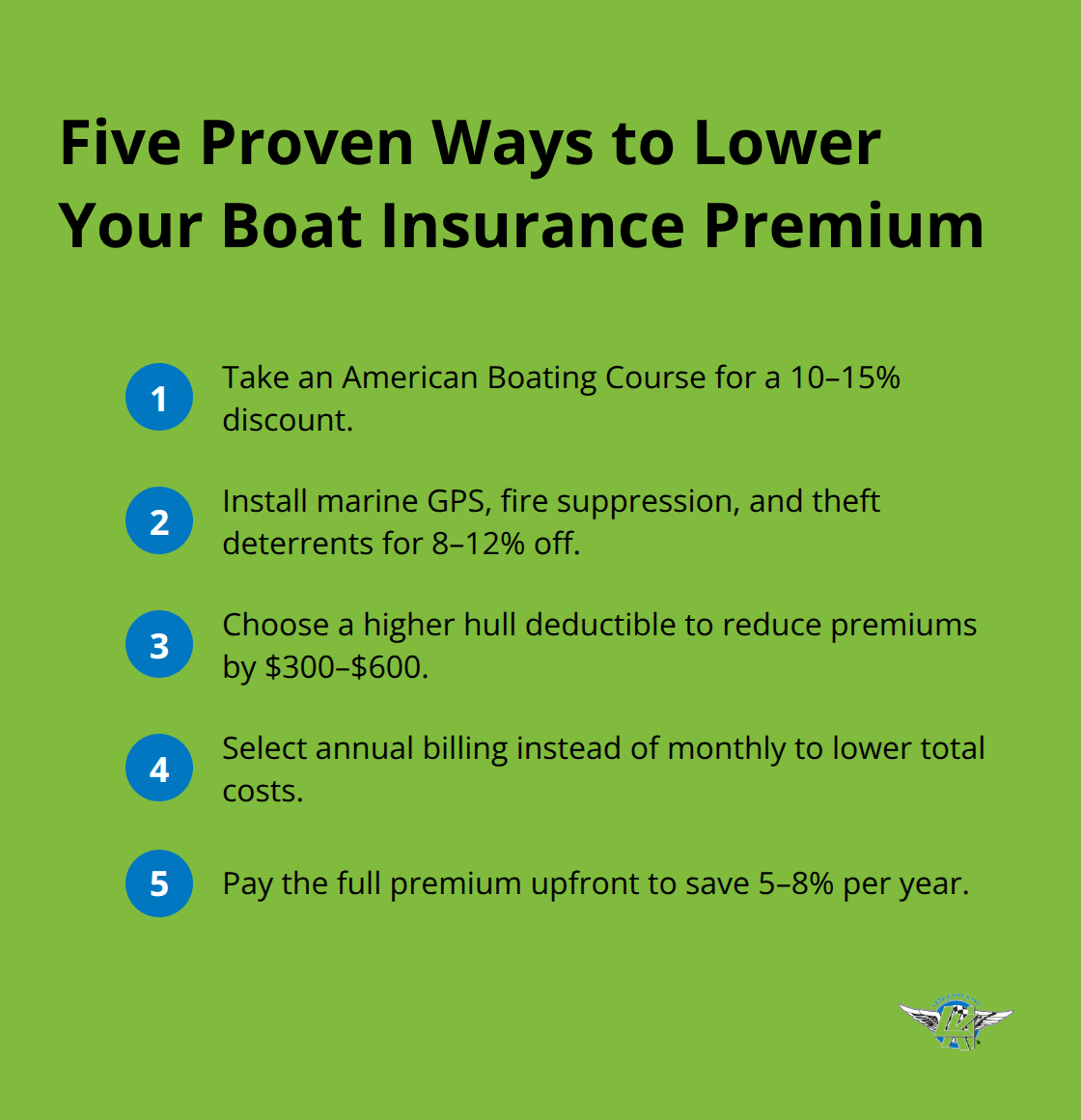
Safety certifications and operator training credentials directly reduce your premium, though most boat owners don’t leverage these discounts aggressively enough. Completing an American Boating Course cuts your annual premium by 10 to 15 percent with most carriers, and this discount stacks with other reductions. Installing a marine-grade GPS system, modern fire suppression equipment, and theft deterrent devices can lower your hull coverage costs by an additional 8 to 12 percent.
How to Find the Best Rates Across Carriers
We recommend obtaining quotes from at least five different carriers because regional insurers often undercut national companies on specific boat types. Nationwide, State Farm, and Progressive dominate the market, but smaller carriers like Boat US Insurance and Geico frequently offer better rates for vessels under $50,000. Your claims history matters enormously-a single prior boat insurance claim increases your next premium by 20 to 40 percent, sometimes for five years or longer.
Strategic Deductible and Payment Choices
This penalty incentivizes choosing higher deductibles on hull coverage to avoid filing minor claims. Setting your hull deductible at $2,500 instead of $500 typically reduces your annual premium by $300 to $600, making this a powerful cost control lever if you have emergency savings to cover unexpected repairs. Annual policies offer better rates than monthly payment options because insurers avoid collection risk and administrative overhead. Paying your full premium upfront rather than in installments saves 5 to 8 percent, a discount that compounds meaningfully over multiple years of boat ownership.
Final Thoughts
Boat policy ownership protects far more than your vessel-it shields your personal assets, keeps you legally compliant, and provides peace of mind on the water. The coverage types we’ve covered, from hull protection to liability limits, work together to create a financial safety net that actually covers real-world accident costs. Most boat owners find that their initial policy falls short when a serious claim arrives, which is why understanding your coverage before you need it matters so much.
Operator error causes roughly 70 percent of boating accidents, uninsured operators represent about 40 percent of recreational boaters, and a single injury claim can easily exceed $250,000. Your state’s minimum liability requirements provide a legal floor, not adequate protection. Try carrying $300,000 to $500,000 in liability coverage, setting reasonable deductibles, and maintaining medical payments coverage at $5,000 minimum to create genuine protection for your situation.
Shopping multiple carriers remains your most powerful cost-control tool-premium quotes for identical boats and coverage often vary by 137 percent or more across different insurers, meaning five minutes of comparison shopping can save $500 to $1,000 annually. Safety certifications, equipment upgrades, and strategic deductible choices compound these savings further. Contact Leslie Kay’s, Inc. to get quotes from carriers that understand your boat and your budget.
The information provided in this blog is for general informational purposes only and does not constitute legal, financial, or insurance advice. Coverage options, terms, and availability may vary. Please consult with a licensed professional for advice specific to your situation.
Artificial intelligence may have been used to generate text and images in some blog articles.