
Buying your first boat is exciting, but the insurance part often feels overwhelming. At Leslie Kay’s, Inc., we’ve helped countless new boat owners navigate this process and find coverage that actually makes sense.
Boat insurance for newbies doesn’t have to be complicated. We’ll walk you through the basics, explain what coverage you actually need, and show you how to compare policies without getting lost in the details.
What Boat Insurance Actually Covers
Boat insurance splits into two fundamental protection areas that work together to shield you financially. Physical damage coverage pays for repairs or replacement when your boat sustains a hit, sinks, catches fire, or falls victim to theft or vandalism. Liability coverage protects you when you’re responsible for injuring someone or damaging their property while operating your boat. Most new boat owners underestimate liability exposure-if you hit another vessel or a swimmer, medical bills and property damage can easily exceed $100,000. Many states don’t legally require boat insurance, but marinas and lenders almost always do, which means you’ll need coverage to dock your boat or finance the purchase. The average recreational boat owner pays $300 to $600 annually, roughly 1.5% of the boat’s value, though this varies dramatically based on your boat type, location, and how you use it.
How Boat Insurance Differs from Your Car Policy
Boat insurance operates under completely different rules than auto insurance because water presents unique risks that roads don’t. Your homeowner’s policy won’t cover your boat, and your auto insurance certainly won’t either. Boats depreciate differently than cars, face weather exposure that changes by season, and operate in environments where you might be far from help. Saltwater boats cost significantly more to insure than freshwater boats because saltwater accelerates corrosion and increases repair expenses. Location matters intensely-a boat moored in coastal Florida with active hurricane seasons runs $839 annually on average, while the same boat in Minnesota might cost only $267. Agreed Value coverage, which locks in a fixed payout amount when you buy the policy, differs fundamentally from Actual Cash Value, which pays depreciated amounts after a loss. Most new boat owners should choose Agreed Value because it protects you from depreciation surprises when you need to file a claim.
What Drives Your Insurance Cost
Your premium depends on factors that marine insurers evaluate carefully. Boat age, condition, and horsepower all increase costs-a 25-year-old boat with a 300-horsepower engine will cost far more to insure than a newer 150-horsepower model. Deductibles heavily influence your price; starting around 1% of your insured boat value, they can climb to 5%, with higher deductibles lowering premiums noticeably. Your boating experience and claims history matter too-younger or less-experienced operators pay more, while a clean three to five-year history unlocks better rates. Completing a certified boating safety course can help you qualify for a discount. Safety equipment like automatic fire extinguishers, bilge detectors, and anti-theft alarms earns premium credits from most insurers. Your driving record and credit score also influence boat rates, which surprises many new owners.
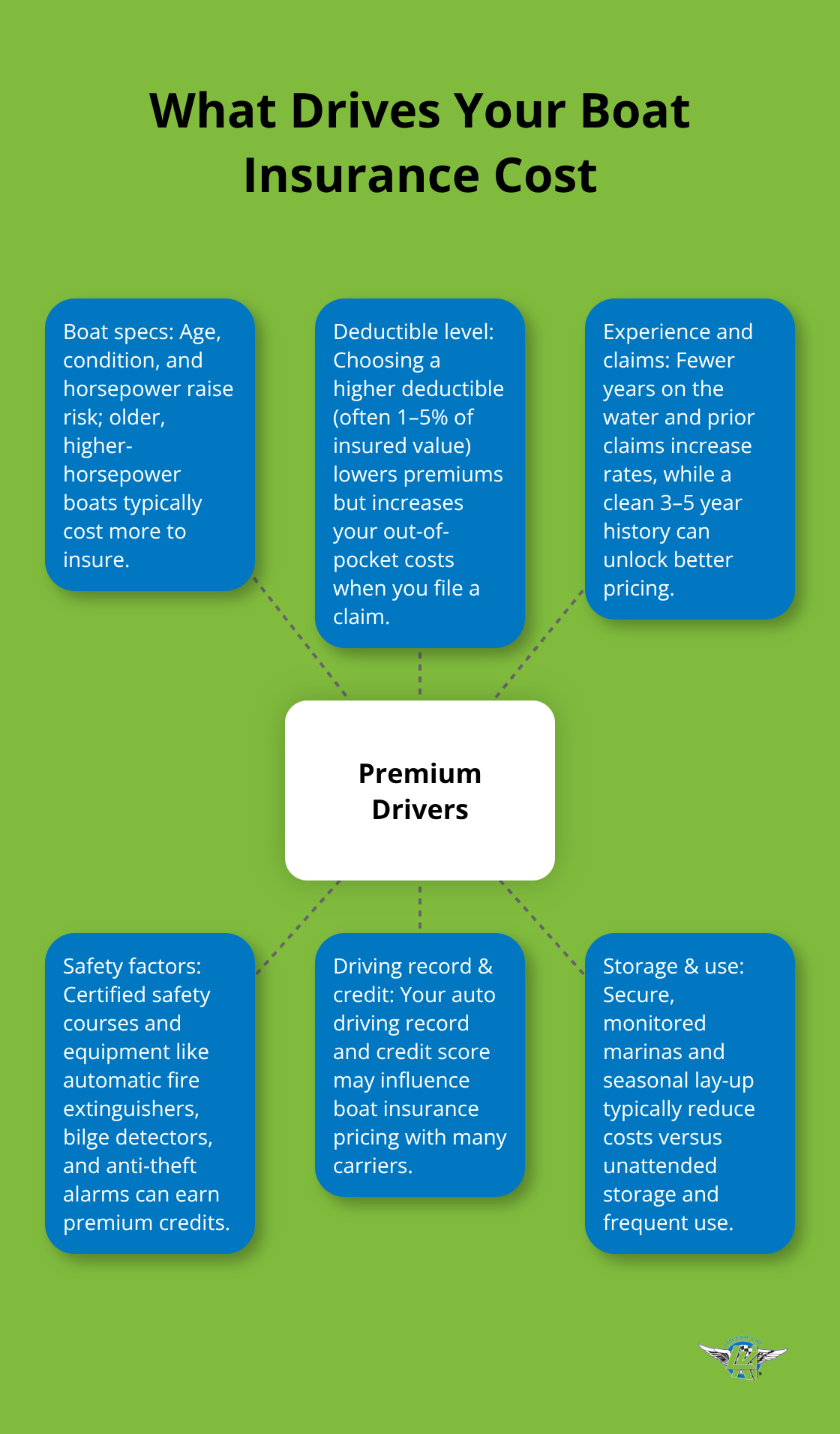
Where you store your boat and how frequently you use it changes everything-boats stored at secure, monitored marinas cost less than those left unattended, and extended lay-up periods during off-season yield notable discounts.
Moving Forward with Coverage Decisions
Understanding what affects your rates helps you make smarter choices about your policy structure. The next chapter walks you through the specific coverage options available and explains which ones matter most for your situation.
Common Coverage Options Explained
Liability Coverage: Your Financial Shield
Liability coverage is non-negotiable, and frankly, most new boat owners underestimate how much they need. This coverage protects you when you’re legally responsible for injuring someone or damaging their property while operating your boat. If you collide with another vessel, hit a swimmer, or cause dock damage, third-party medical bills and property damage claims escalate fast-easily exceeding $100,000 in serious incidents. Many marinas require minimum liability coverage before you can dock, and lenders demand it to protect their investment in your boat. The Oil Pollution Act caps your environmental cleanup liability at $939,800 if your boat spills fuel or oil, which sounds distant until you realize a single incident could trigger massive costs.
Physical Damage: Agreed Value vs. Actual Cash Value
Physical damage coverage splits into two approaches: Agreed Value locks in a fixed payout amount when you purchase the policy, while Actual Cash Value pays the depreciated market value at loss. For new boat owners, Agreed Value wins every time because it eliminates depreciation surprises-a $50,000 boat financed today might depreciate to $35,000 in five years, and Actual Cash Value would pay that lower amount after a total loss. Collision and comprehensive protection cover different scenarios: collision handles impact damage from hitting objects or other boats, while comprehensive covers fire, theft, vandalism, and weather events. Most policies bundle these together in an all-risk format unless you specifically exclude them, which we’d strongly advise against for financed boats.
Medical Payments and Uninsured Boater Protection
Medical Payments coverage reimburses medical expenses for you and your passengers after a boating accident, regardless of fault, with typical per-person limits ranging from $500 to $5,000 and annual claim limits varying by policy. A simple fall while boarding or a head injury from rough water can generate $10,000 in emergency room and follow-up care costs, making this coverage practical rather than theoretical. Uninsured Boater coverage protects you when another operator lacks insurance or carries insufficient coverage-a real risk since boat insurance isn’t legally mandated in most states, meaning plenty of uninsured operators navigate the water daily. This coverage typically mirrors your liability limits and activates when you’re hit by someone who can’t pay for damages.
Building Your Coverage Foundation
Start with liability limits of at least $300,000, Agreed Value physical damage coverage, comprehensive and collision protection, Medical Payments of $1,000 minimum per person, and Uninsured Boater coverage matching your liability limits. Your deductible choice directly impacts your premium: selecting $2,500 instead of $500 might save 15-20% annually, but that’s out-of-pocket money you’ll pay on any claim. New boat owners typically benefit from moderate deductibles around $1,000-$2,500 that balance affordability with manageable claim costs. These foundational choices set you up well, but the real savings come when you compare what different carriers actually offer and how their quotes stack up against each other.
Choosing the Right Boat Insurance Policy
Gather Your Boat Details and Shop Multiple Carriers
Multiple carriers offer boat coverage, but their quotes for the same boat swing $200 to $500 annually depending on how they assess risk. Progressive, GEICO, Allstate, Nationwide, State Farm, Travelers, and Farmers all compete for your business, yet no single insurer consistently offers the lowest price. Start by collecting your boat’s specifics: year, make, model, length, engine horsepower, Hull Identification Number, current value, storage location, and any safety equipment you’ve installed. Most insurers let you obtain quotes in minutes through their websites, and independent marine brokers access 50-plus carriers simultaneously, which saves time and often uncovers better rates than shopping individually. The trap most new owners fall into involves picking the lowest quote without understanding what’s actually included-a $300 annual policy might carry a $5,000 deductible and only $100,000 liability, while a $450 policy covers you far more comprehensively.
Balance Your Deductible Against Premium Savings
Deductibles directly control your premium costs: jumping from $500 to $2,500 typically saves 15-20% annually, but that’s money out of your pocket when you file a claim. For a $50,000 boat, a $1,000 deductible strikes the right balance-low enough that a minor accident doesn’t devastate your finances, high enough to meaningfully reduce your premium. Your boating location dramatically influences pricing: a boat in Minnesota costs roughly $267 annually versus $839 in coastal Florida for identical coverage, which is why location-specific quotes matter far more than national averages.
Choose Between Agreed Value and Actual Cash Value
Your boat’s actual market value determines whether Agreed Value or Actual Cash Value makes financial sense. If you financed a $60,000 boat, that’s your Agreed Value amount at purchase, protecting you from depreciation when you need to claim a total loss. If your boat depreciates to $40,000 in three years and you select Actual Cash Value instead, that’s the amount you’d receive after a total loss-a $20,000 hit that surprises most owners. Check whether your insurer requires a marine survey for coverage eligibility; older boats or those over certain values often need one, and a recent survey actually proves your boat’s condition, which can lower premiums. Some insurers offer survey discounts if you complete one proactively, turning a potential cost into a rate reduction.
Verify Coverage Limits and Identify Available Discounts
When comparing quotes, verify that coverage limits match across policies-$300,000 liability isn’t standard everywhere, and some carriers default to lower amounts. Ask each insurer about available discounts: bundling boat insurance with your home or auto policy typically cuts 10-15% off the boat premium, completing a boater safety course earns discounts for three years, and having safety equipment like fire extinguishers or GPS installed qualifies you for credits. Storage type matters significantly in pricing-a boat at a secure, monitored marina costs less than one left unattended in your driveway, and seasonal lay-up during winter months generates noticeable savings for boats that sit unused for extended periods.
Evaluate Claims Support and Policy Details
Once you’ve narrowed your options to two or three carriers with comparable coverage and pricing, read the policy details carefully: check claims response times, whether they handle claims in-house or use third-party adjusters, and whether they offer 24/7 support for emergencies on the water. The insurer you select should respond quickly when you need help, not months later when the damage has compounded.
Final Thoughts
Boat insurance for newbies requires three core decisions: selecting the right coverage types, balancing your deductible against premium costs, and comparing quotes from multiple carriers before you commit. Agreed Value protects you from depreciation surprises, liability coverage shields you from catastrophic financial exposure, and your location plus boat details dramatically influence what you’ll pay annually. The average recreational boat owner spends $300 to $600 per year, roughly 1.5% of boat value, but your actual cost depends entirely on the choices you make about coverage limits and deductibles.
Start your coverage journey by gathering your boat’s specifics and obtaining quotes from at least three carriers-Progressive, GEICO, Allstate, Nationwide, State Farm, Travelers, and Farmers all compete for your business, and independent marine brokers can access 50-plus carriers simultaneously to find better rates than shopping individually. When you receive quotes, compare not just the premium but the deductible amounts, coverage limits, and available discounts for bundling, safety courses, or equipment installations. Don’t select the lowest quote without understanding what’s included, as a cheap policy with a $5,000 deductible and minimal liability coverage leaves you exposed when you actually need protection.
Building long-term confidence on the water starts with coverage that matches your actual usage and boat value. Review your policy annually as your boat depreciates or you upgrade equipment, and adjust coverage limits accordingly. At Leslie Kay’s, Inc., we specialize in watercraft coverage and shop multiple carriers to deliver customized policies with hands-on claims support and seven-day-a-week service.
The information provided in this blog is for general informational purposes only and does not constitute legal, financial, or insurance advice. Coverage options, terms, and availability may vary. Please consult with a licensed professional for advice specific to your situation.
Artificial intelligence may have been used to generate text and images in some blog articles.