

RV travel across multiple states requires insurance that keeps pace with your journey. Standard policies often leave gaps when you cross state lines, exposing you to unexpected liability and coverage issues.
At Leslie Kay’s, Inc., we help RV owners navigate the complexities of multistate coverage. This guide walks you through what you need to protect your investment, no matter where the road takes you.
What Multistate RV Insurance Actually Covers
Comprehensive Protection Across State Lines
Multistate RV insurance protects your motorhome or travel trailer across state lines with comprehensive and collision coverage that moves with you, regardless of where you park. Damage from accidents, theft, fire, vandalism, and weather receives coverage in Arizona just as it does in Florida. Liability protection follows you too-it covers bodily injury and property damage you cause to others while operating your RV, which is legally required in nearly every state for motorized vehicles. Roadside assistance tailored for RVs covers towing, tire changes, jump-starts, and locksmith services for large vehicles, so you won’t get stranded on unfamiliar highways.
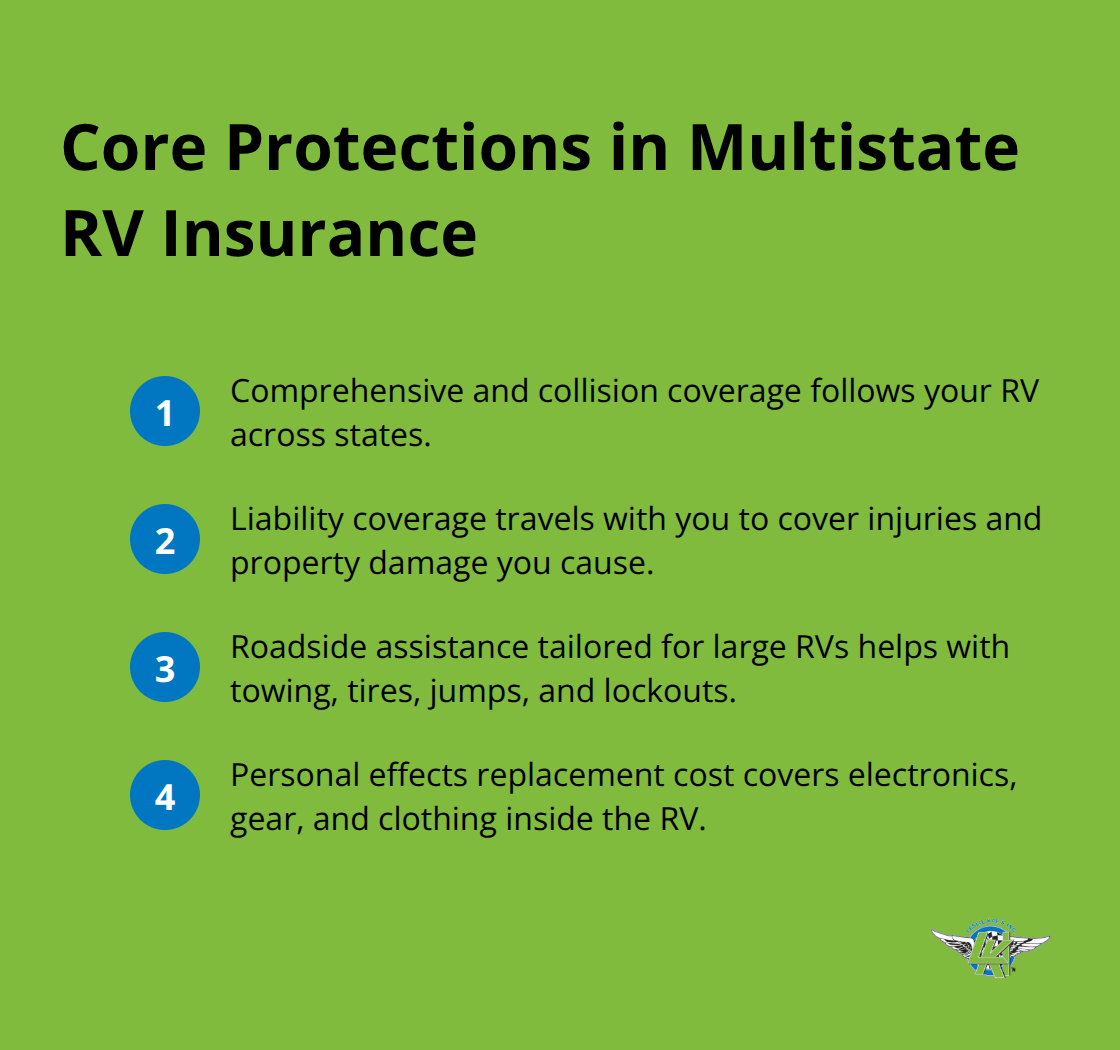
Personal effects replacement cost protects belongings inside the RV like electronics, gear, and clothing if damaged or stolen.
Additional Protections for Full-Time Travelers
Many policies include uninsured or underinsured motorist coverage, which helps when another driver carries little or no insurance. For full-time RVers, policies can add medical payments coverage for injuries inside the RV, loss assessment coverage for RV association fees, and emergency expense allowance that reimburses food, transportation, and lodging while your RV undergoes repair after a covered loss. These add-ons transform standard RV coverage into homeowner-like protection that addresses the unique risks of living on the road.
Why Standard Policies Create Gaps
The critical difference between multistate policies and standard RV insurance is that your coverage adapts to each state’s specific liability requirements without forcing you to cancel and restart policies. Standard policies often require you to list where your RV is garaged, and crossing into states with different coverage minimums creates gaps. Some states require higher liability limits than others, and if your policy is written for one state’s minimums, you’re technically underinsured when you travel. Multistate coverage means one policy handles liability requirements across all the states you visit, eliminating the need to juggle multiple policies or worry about compliance. You also avoid the hassle of switching carriers and coverage levels as you move between states, which can take weeks and leave you temporarily unprotected.
Investment Protection for Your Assets
Full-time RVers especially benefit because policies can be customized for higher limits and homeowner-like protections that standard policies don’t offer. Annual premiums for full-time RV insurance typically range from a few hundred to several thousand dollars depending on RV type, value, and coverage selections, but that investment protects assets worth tens to hundreds of thousands of dollars. Understanding what your policy actually covers across different states sets the foundation for choosing the right plan. The next step involves comparing specific coverage options and evaluating how different carriers handle multistate flexibility.
Picking the Right Multistate Policy for Your RV
Compare What Carriers Actually Offer Across State Lines
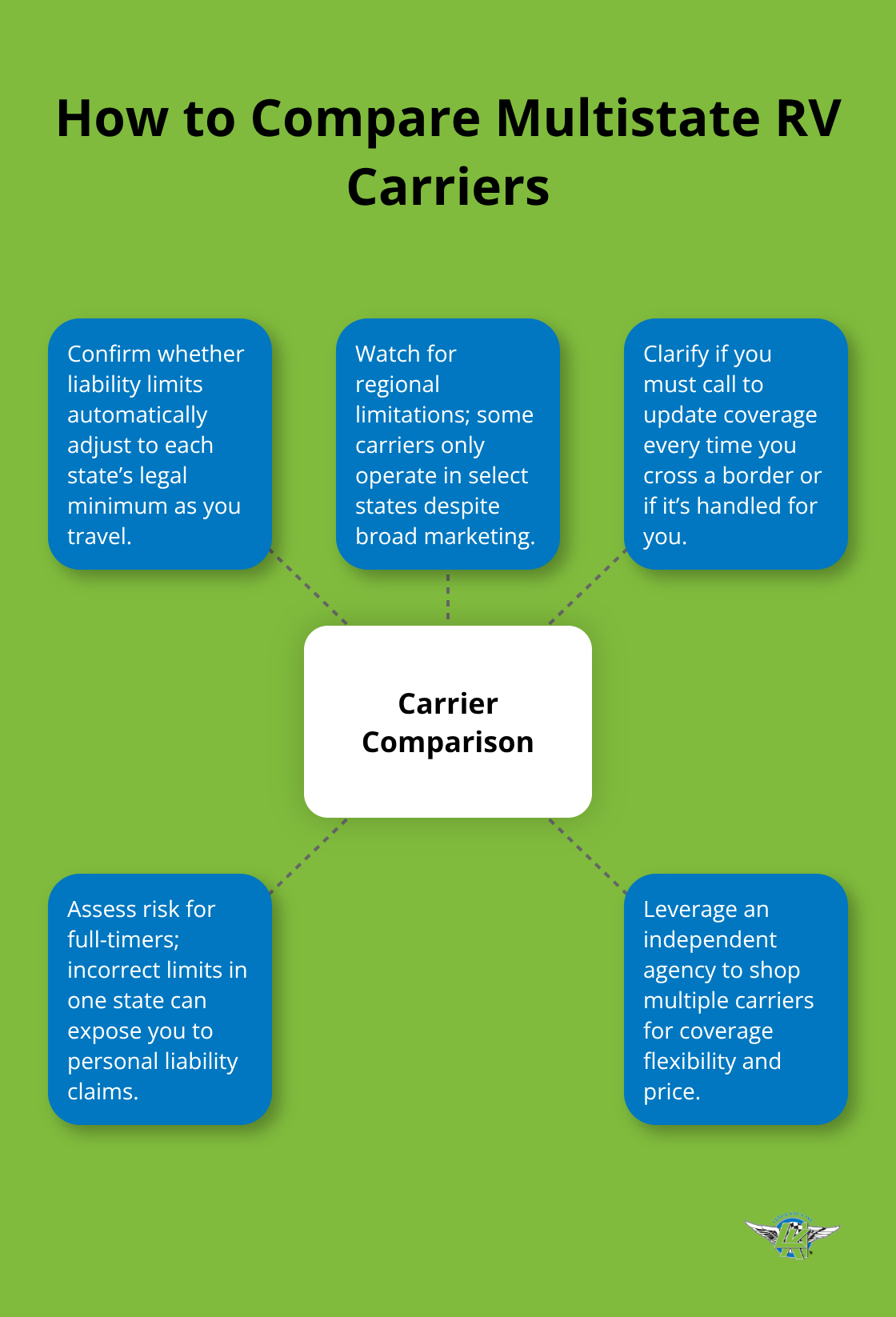
Selecting multistate RV insurance means comparing what carriers actually offer across state lines, not just looking at advertised rates. Most independent agencies shop multiple carriers to secure stronger coverage at competitive prices, which matters because RV policies vary significantly by insurer and state. You need to know whether a carrier’s liability limits automatically adjust to meet each state’s legal minimums or if you must manually update coverage as you travel. Some carriers cap their multistate flexibility to specific regions-Armored Insurance, for example, operates in nine states including Washington, Arizona, Oregon, California, Idaho, Texas, Colorado, Nevada, and Oklahoma-while others claim nationwide coverage but exclude certain areas. Ask your agent directly: does this carrier handle liability compliance automatically across all states you’ll visit, or do you need to call and adjust coverage each time you cross a border? Full-time RVers especially need answers here because incorrect liability limits in even one state expose you to personal liability claims that your insurance won’t cover.
Understand Premium Costs and Coverage Trade-Offs
Premium costs for full-time RV insurance typically range from several hundred to several thousand dollars annually depending on RV type, value, deductibles, and coverage selections. The real comparison isn’t just the base premium-it’s what additional protections cost and whether they’re worth adding. Personal effects replacement coverage protects electronics and gear inside your RV and costs more but prevents catastrophic loss if theft or fire strikes. Medical payments coverage and emergency expense allowance add significant value for full-timers, reimbursing lodging and meals while your RV undergoes repair after a covered loss, yet many standard quotes exclude these. When you request quotes, provide exact details about your RV, annual mileage, states you’ll visit, and how many months annually you travel-vague information produces vague quotes that don’t reflect your actual needs.
Evaluate Multiple Carriers on Identical Terms
Comparing three to four carriers on identical coverage terms reveals which offers the best value for multistate flexibility rather than relying on brand reputation alone. An independent agency that shops multiple carriers (as Leslie Kay’s, Inc. does for motorcycle, RV, auto, and watercraft coverage) can deliver customized, competitively priced policies tailored to your specific travel patterns and asset value. This approach ensures you don’t overpay for coverage you don’t need or underpay and miss critical protection. The carriers you compare should all address the same question: how do they handle state-specific liability requirements as you move between regions? Once you’ve narrowed your options based on coverage flexibility and premium costs, the next step involves identifying common gaps that even solid policies can miss.
Common Gaps in RV Insurance and How to Avoid Them
Personal Belongings and Roadside Assistance Limits
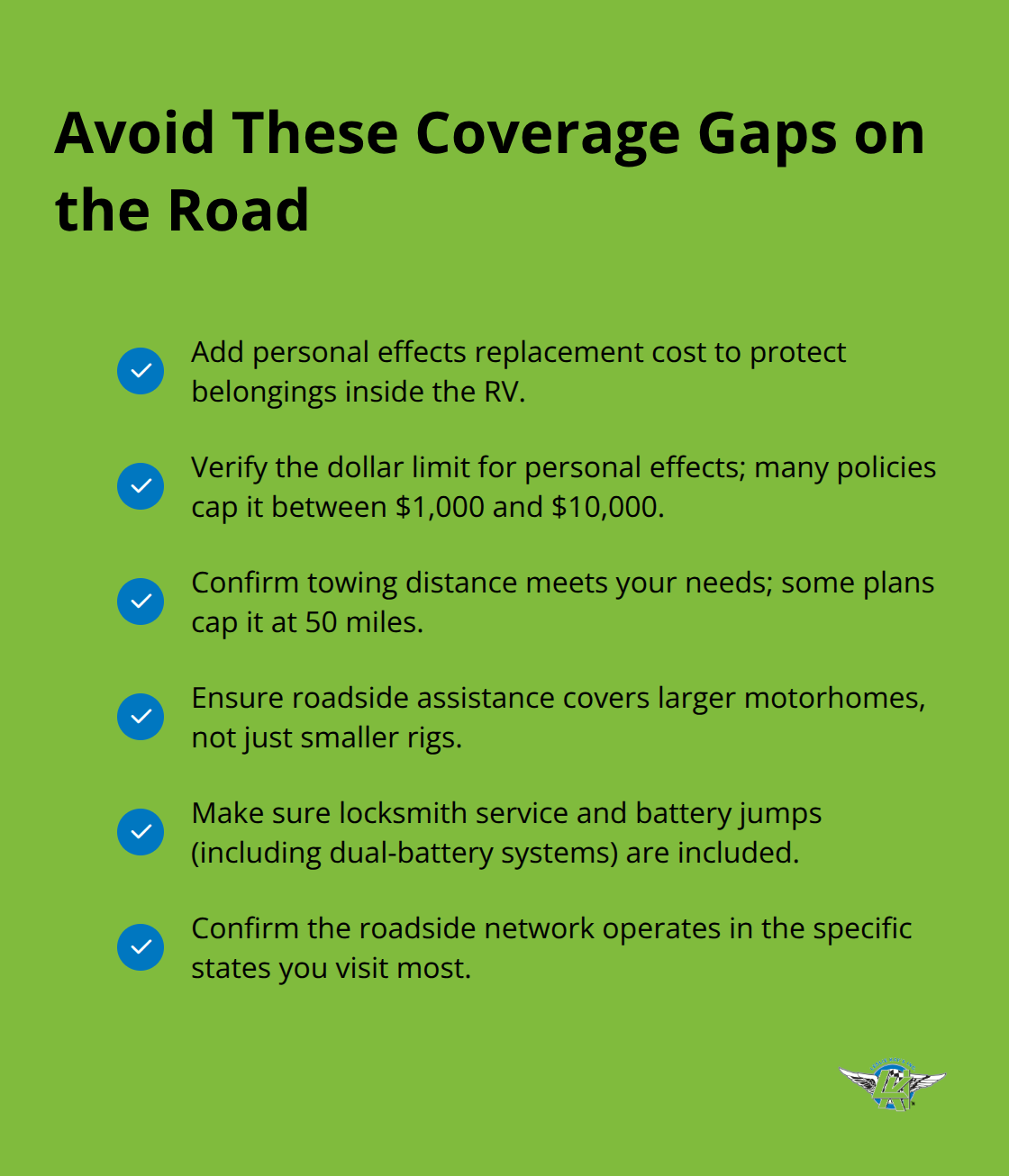
Most RV policies sold today have three blind spots that catch owners mid-trip when they discover coverage doesn’t exist or falls far short. Personal belongings inside your RV-electronics, camping gear, tools, clothing-often aren’t covered under standard comprehensive and collision coverage, which protects only the vehicle structure itself. A laptop, drone, or high-end camera stolen from your parked RV at a campground leaves you unprotected unless your policy specifically includes personal effects replacement cost. Request quotes that include this coverage and ask the carrier what dollar limit applies, because limits typically range from $1,000 to $10,000 and won’t cover a fully equipped RV interior. Roadside assistance marketed as standard in many policies also has restrictions most owners miss: some carriers limit towing distance to 50 miles or exclude service for larger motorhomes, and not all cover the cost of a locksmith for RV entry or battery jumps for dual-battery systems. Before purchasing, ask your agent for the exact towing distance, which service calls are included, and whether the roadside network operates in the specific states where you travel most frequently.
Liability Coverage Across State Lines
Liability coverage across state lines creates dangerous gaps because legal requirements vary dramatically by state, and carriers handle compliance differently. Some states require 15/30/5 liability limits (15,000 bodily injury per person, 30,000 per accident, 5,000 property damage), while others demand 25/50/25 or higher, yet many policies are written for the minimum in one state and don’t automatically adjust when you cross borders. Full-time RVers face the biggest exposure because living in your RV for six months or more means extended time in multiple states, and a single accident in a high-liability state without adequate coverage could result in personal judgment against you for amounts your policy won’t cover. Verify with your carrier or agent that liability limits automatically adjust to meet each state’s legal minimum as you travel, or request limits higher than any state you’ll visit requires-many agents recommend 100/300/100 as a baseline for multistate travelers.
Medical Payments and Emergency Expense Coverage for Full-Timers
Medical payments coverage and emergency expense allowance matter more for full-timers than weekend travelers because injuries inside your RV or damage requiring repair means lodging and meal costs accumulate quickly when your home is being fixed. Ask specifically whether your quote includes emergency expense allowance reimbursement for food and lodging during repairs, and what the daily or total limits are-some policies cap reimbursement at $50 per day while others allow $200 or more.
Final Thoughts
Selecting multistate RV insurance requires you to verify that liability coverage adjusts automatically to each state’s legal requirements, confirm that personal belongings and roadside assistance limits match your actual needs, and validate that full-timer protections like emergency expense allowance appear in your policy. Too many RV owners uncover gaps only after an accident or theft strikes, when adding coverage becomes impossible. The carriers you compare should handle state-specific compliance without forcing you to call and adjust coverage each time you cross a border.
We at Leslie Kay’s, Inc. specialize in this exact work as an independent agency that shops multiple carriers to deliver customized multistate RV insurance policies tailored to your specific travel patterns and asset value. We understand the unique risks RV owners face across different states because we’ve built our practice around protecting vehicles and adventures. Our team handles the complexity of multistate compliance so you focus on the road ahead.
Contact Leslie Kay’s, Inc. to request a customized quote for multistate RV insurance and gain clarity on coverage that actually travels with you.
The information provided in this blog is for general informational purposes only and does not constitute legal, financial, or insurance advice. Coverage options, terms, and availability may vary. Please consult with a licensed professional for advice specific to your situation.
Artificial intelligence may have been used to generate text and images in some blog articles.