
Boat insurance feels unnecessarily complicated, with confusing terms and rates that seem to jump around for no clear reason. We at Leslie Kay’s, Inc. believe pleasure craft insurance rates should make sense to the people paying them.
This guide breaks down exactly what goes into your quote, which factors actually matter, and how to pay less without sacrificing protection.
What Your Boat Insurance Quote Actually Covers
Your boat insurance quote breaks down into three essential components that directly affect what you pay and what protection you get. The first is hull coverage, which protects the physical structure of your boat. This is where the Agreed Value versus Actual Cash Value decision matters most.
Hull Coverage and Agreed Value Protection
With Agreed Value, you and your insurer lock in a replacement amount upfront-say $35,000 for your center console fishing boat. If total loss happens, you get that $35,000, period. Actual Cash Value pays depreciated value at claim time, meaning a $35,000 boat that’s eight years old might only net you $18,000 after depreciation calculations. For most boat owners, Agreed Value makes sense because it removes the guesswork and protects you from depreciation erosion.
The hull coverage also includes your engine, sails if applicable, and onboard equipment, but normal wear and tear does not qualify. Some policies also cover the boat during land storage or trailer transport, so verify that’s included before you buy.
Liability Coverage and Legal Responsibility
Liability coverage is where financial exposure becomes real. This covers your legal responsibility if you hit another boat, damage someone’s dock, or injure a passenger. Many marinas require proof of liability insurance before they’ll let you dock, and if you’re financing your boat, your lender mandates it as a loan condition. Standard liability limits typically run $100,000 to $300,000 per occurrence, but coastal states and high-value boats often need higher limits.
Protection Against Uninsured Boaters
Uninsured Boater coverage helps cover your injuries or your passenger’s injuries caused by another boater with little to no liability insurance. Medical Payments coverage handles first aid and medical costs for injuries on board-someone slips on deck, breaks an arm, and the policy covers treatment up to your per-person limit (typically $1,000 to $5,000).
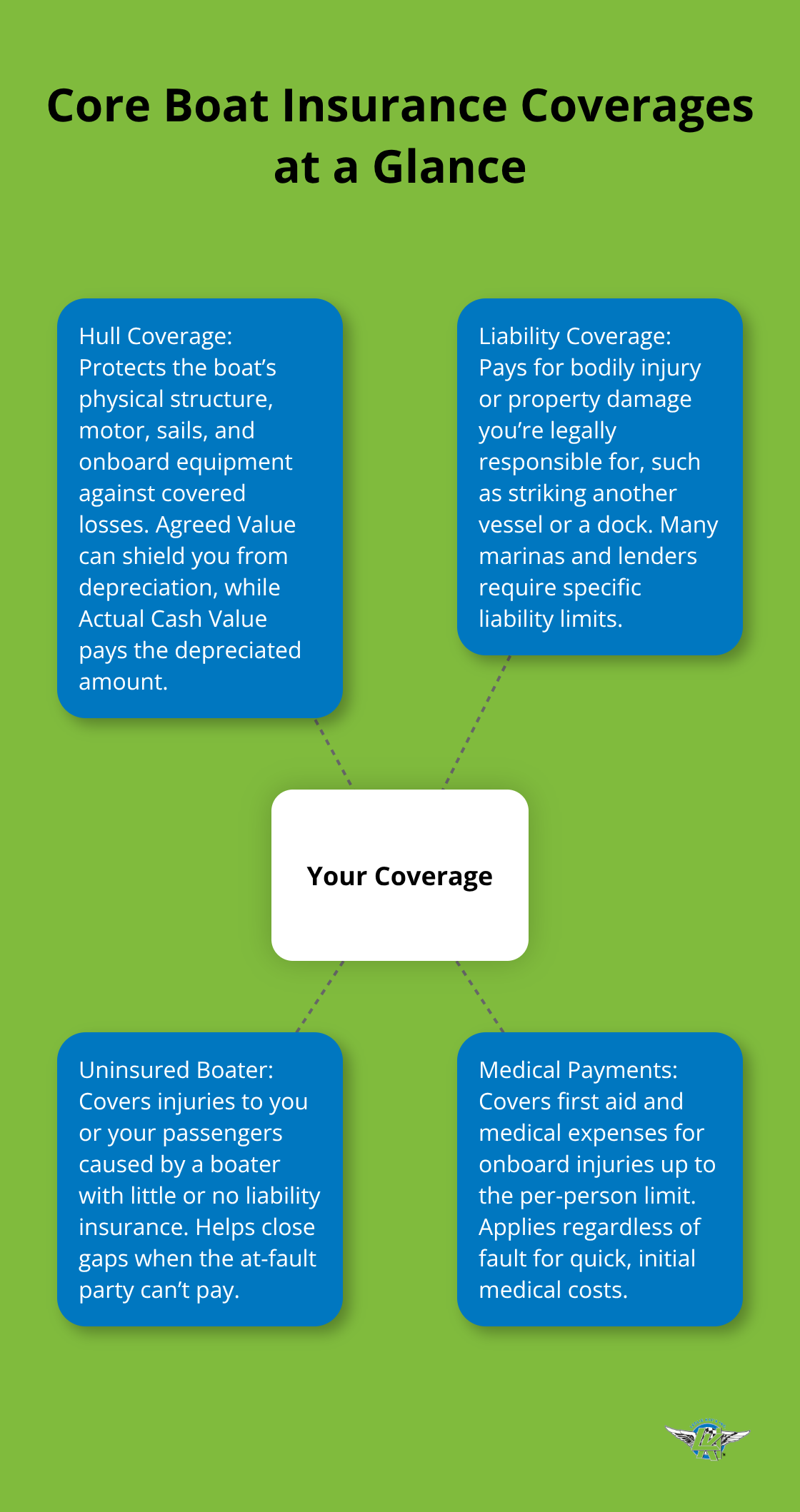
These three coverage types form the foundation of your protection, but the rates you pay for them depend heavily on factors specific to your boat, your experience, and where you actually operate it.
What Really Drives Your Boat Insurance Price
Your boat’s age, type, and engine power form the foundation of how insurers calculate your premium, and these factors move rates in predictable directions. A brand-new 300-horsepower center console costs significantly more to insure than a 10-year-old 150-horsepower pontoon boat, even if they sit at the same marina. Newer boats command higher premiums because they carry higher replacement costs-a $250,000 vessel obviously costs more to replace than a $50,000 one. Engine horsepower matters because higher power means greater speed capability and, in insurers’ eyes, greater accident risk. Diesel-powered boats sometimes qualify for a physical damage discount, but outboard motors, especially multiple ones, often earn credits instead of surcharges.
Boat Type and Your Risk Profile
The boat type itself carries distinct risk profiles: fishing boats, sailboats, and pontoons all present different exposure levels to underwriters. Your specific vessel design influences how insurers assess the likelihood of damage or liability claims. This is why two boats of similar age and value can carry very different premiums based on their hull design and intended use.
Experience and Claims History Shape Your Rate
Your boating experience directly impacts your rate in ways many owners don’t realize. A boater with 20 years of experience and no claims history pays substantially less than someone buying their first boat-sometimes 15 to 25 percent less depending on the carrier. Completing a boating safety course through the US Coast Guard Auxiliary or US Power Squadron typically yields a 5 to 10 percent discount and demonstrates competence to underwriters.
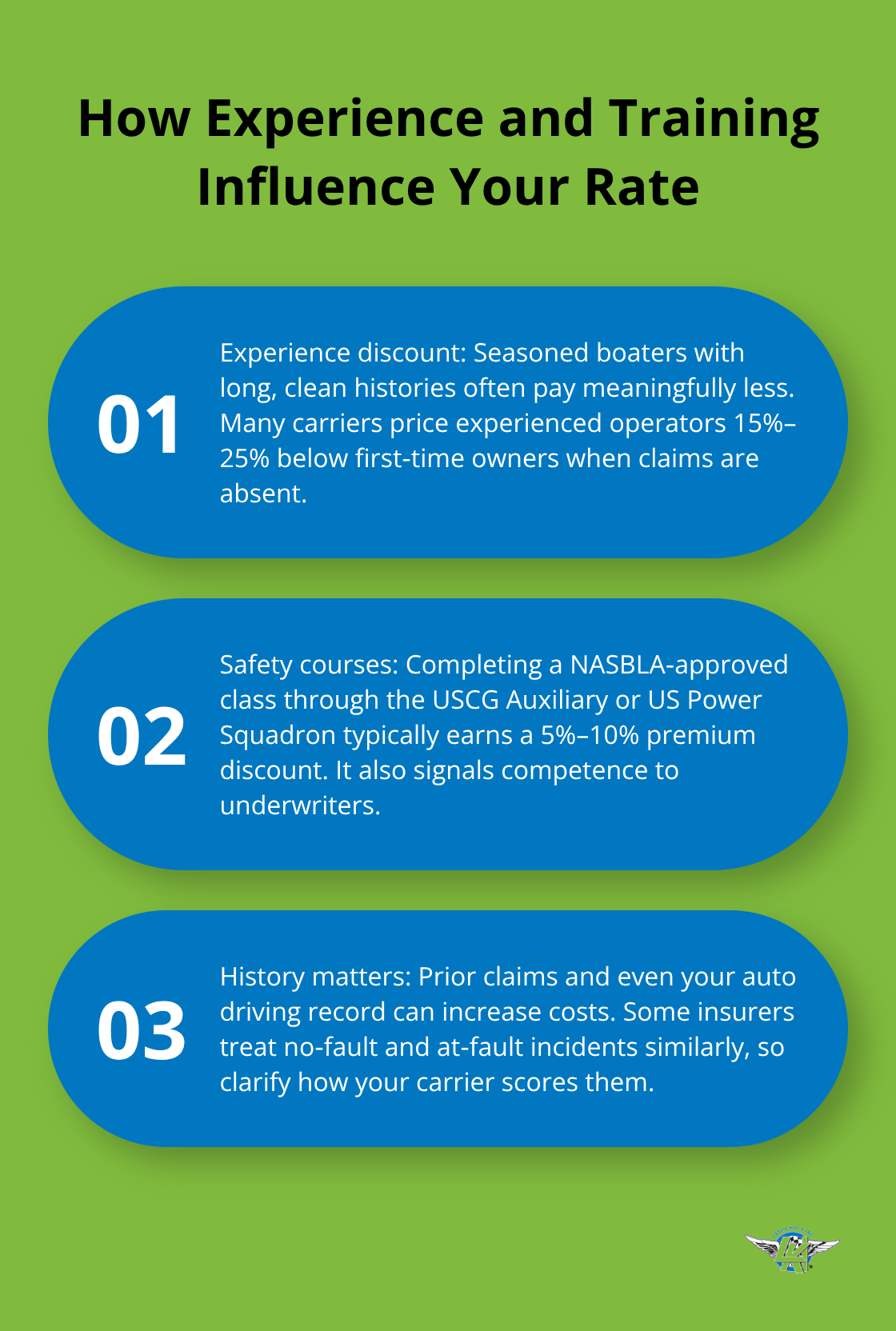
Prior claims matter enormously; some insurers don’t distinguish between at-fault and no-fault incidents, so clarify your carrier’s policy before signing. Your driving record on your auto insurance also factors in, since insurers view responsible drivers across all vehicles as lower-risk clients.
Location and Boating Season
Where and how often you operate your boat determines exposure better than almost any other single factor. A boat that stays moored at an inland marina on a Great Lakes location costs far less to insure than an identical boat docked in Miami or Charleston. Florida consistently ranks among the highest-cost states for boat insurance, with Progressive’s 2023-2024 data showing average annual premiums around $839, while Minnesota averages just $267 for the same coverage. Hurricane risk, longer boating seasons, and saltwater corrosion drive coastal premiums upward. Great Lakes states fall into the low-cost category because boating there tends to be seasonal and inland-focused rather than exposed to open-water conditions.
Usage Patterns and Navigation Limits
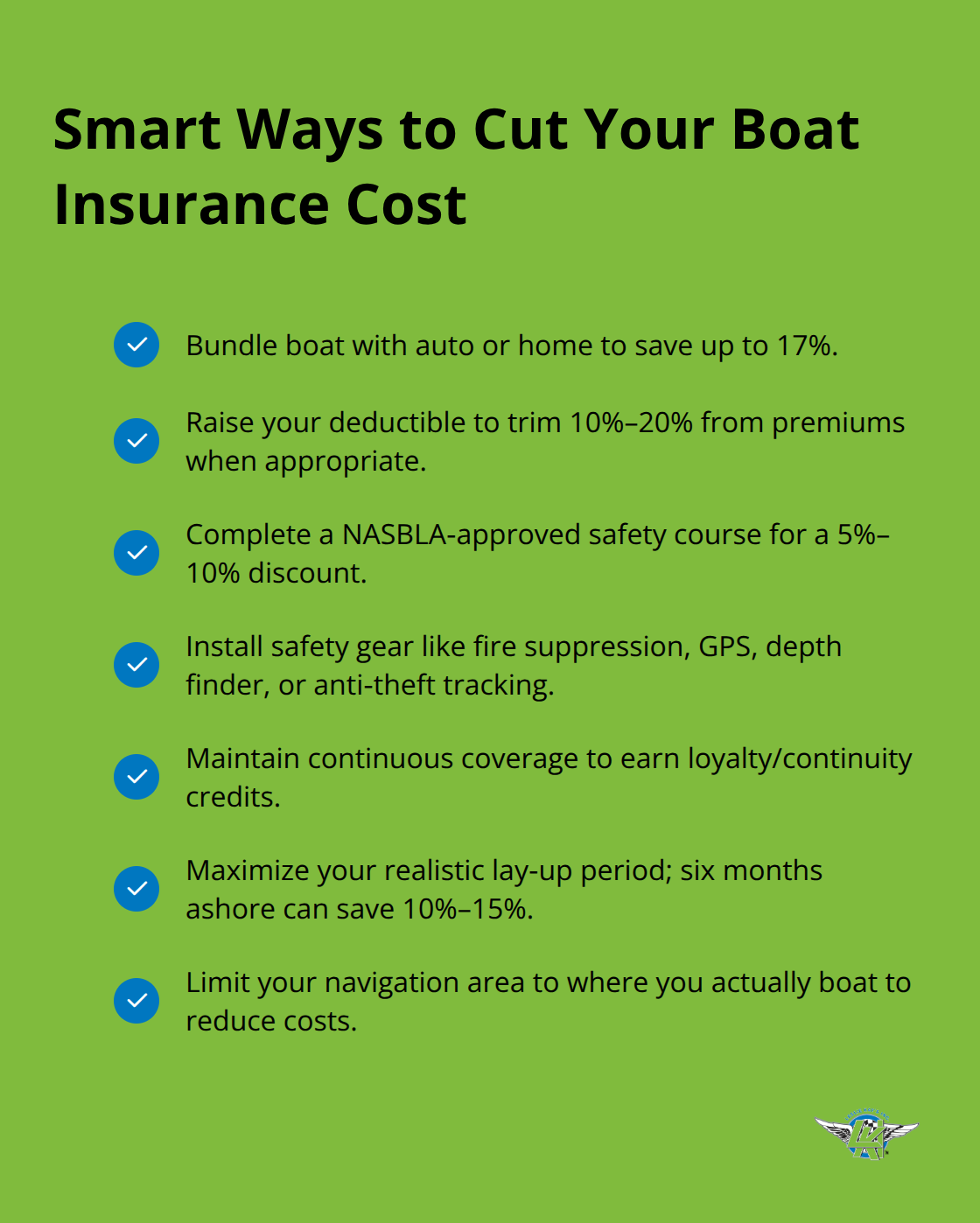
How often you actually use the boat matters too-a boat that sits in winter storage for five months qualifies for a lay-up discount that can meaningfully reduce your annual premium. Request the longest reasonable lay-up period your actual use supports; some carriers credit these periods at rates that add up to real savings. Limiting your navigational area to where you genuinely operate also lowers costs; you don’t need coverage for Bahamas cruising if you never leave your home state. The combination of your experience level, your boat’s specifications, and your actual usage patterns create your individual risk profile. Understanding these factors helps you see why your quote looks the way it does-and it also reveals which levers you can actually pull to pay less without sacrificing the protection you need.
Practical Ways to Cut Your Boat Insurance Costs
Bundle Policies to Slash Your Premium
Bundling your boat insurance with your auto or homeowners policy can save up to 17% on average, and some carriers push discounts even higher when you stack multiple coverages. Progressive, State Farm, Allstate, and other major carriers all reward policy bundling, so if you’ve shopped boat insurance separately, you’re likely leaving money on the table. The math is straightforward: a boat owner paying $500 annually for standalone boat coverage might drop that to $425 or $450 when bundled with an auto policy.
Adjust Your Deductible to Match Your Budget
Your deductible choice directly controls what you pay each month. Increasing your deductible from $500 to $1,000 or $2,500 can reduce your premium by 10 to 20 percent depending on your boat’s value and the carrier. The key is matching your deductible to what you can actually afford out of pocket if a claim happens, not just chasing the lowest monthly payment. If you have a newer boat worth $100,000, a comprehensive coverage option with a $2,500 deductible remains manageable while cutting your premium meaningfully.
Install Safety Equipment and Earn Credits
Safety equipment and boating certifications deliver concrete rate reductions that many owners overlook. Completing a NASBLA-approved boating safety course through the US Coast Guard Auxiliary or US Power Squadron yields a 5 to 10 percent discount with most carriers, and that credential stays with you for several years. Installing automatic fire suppression in your engine compartment, GPS systems, depth finders, or anti-theft tracking devices all earn premium credits because they reduce risk. Real-time GPS monitoring with geofencing capabilities lowers your premium by signaling theft prevention to underwriters.
Maintain Continuity and Extend Your Lay-Up Period
Loyalty matters: insurers often credit existing customers who maintain continuous coverage without lapses, rewarding you for staying with the same carrier. If you’ve held your policy for three or more years without a break, ask specifically what continuity discounts apply. Requesting a longer lay-up period during winter months or off-season storage credits your premium at rates that genuinely add up. A boat stored ashore for six months instead of three can save you 10 to 15 percent annually, so match your lay-up period to your actual usage patterns and notify your carrier when you pull the boat for the season.
Final Thoughts
Understanding what drives your pleasure craft insurance rates puts you in control of your coverage and your costs. You now know that hull protection, liability limits, and uninsured boater coverage form your foundation, and you understand exactly which factors-boat age, your experience, location, and usage patterns-determine what you actually pay. Shopping multiple carriers reveals the real power in this knowledge: Progressive, State Farm, Allstate, and United Marine all price risk differently, which means the same boat can carry premiums ranging from $300 to $600 annually depending on which company quotes you.
Navigating pleasure craft insurance rates alone takes time and requires knowing which questions to ask. We at Leslie Kay’s, Inc. specialize in watercraft coverage and shop multiple carriers on your behalf, handling the complexity so you don’t have to. Our team understands the specific factors that affect your boat, your experience level, and your actual boating patterns-and we use that knowledge to find you competitive rates with hands-on support when you need it.
Rather than piecing together quotes yourself, contact us and let us do the work. We deliver you a customized policy that protects your investment without overpaying.
The information provided in this blog is for general informational purposes only and does not constitute legal, financial, or insurance advice. Coverage options, terms, and availability may vary. Please consult with a licensed professional for advice specific to your situation.
Artificial intelligence may have been used to generate text and images in some blog articles.