
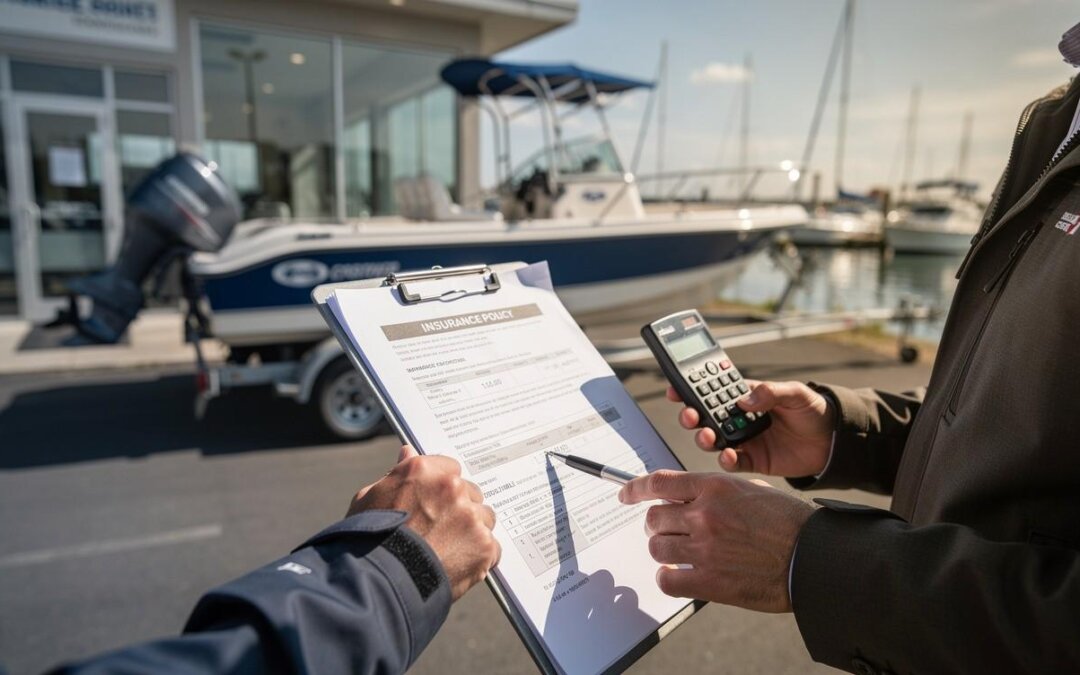
Boat insurance deductibles confuse most boat owners, but they don’t have to. The amount you choose directly impacts both your monthly premiums and what you’ll pay out of pocket when you file a claim.
We at Leslie Kay’s, Inc. help boat owners understand these tradeoffs so they can make smarter coverage decisions. This guide breaks down how deductibles work and shows you exactly how to save money without sacrificing protection.
What Your Boat Deductible Actually Means
A boat insurance deductible is the amount you pay out of your own pocket when you file a claim, and your insurance company covers the rest. If your boat suffers hull damage worth $5,000 and you have a $500 deductible, you pay $500 and your insurer pays $4,500. The deductible applies to physical damage claims like collisions, weather damage, and equipment failures. However, here’s the detail most boat owners miss: the hull deductible does not apply to total loss claims. If your boat is declared a total loss, you receive the full payout without subtracting your deductible. This means choosing a higher deductible to lower your premiums carries far less risk than boat owners typically assume.
Understanding Percentage vs. Flat Deductibles
Boat insurance companies offer deductibles in two structures. The first uses percentages of your boat’s insured value, typically ranging from 1% to 5%. A boat valued at $40,000 with a 1% deductible means you pay $400 per claim. The second uses flat dollar amounts like $250, $500, $750, or $1,000, regardless of boat value.
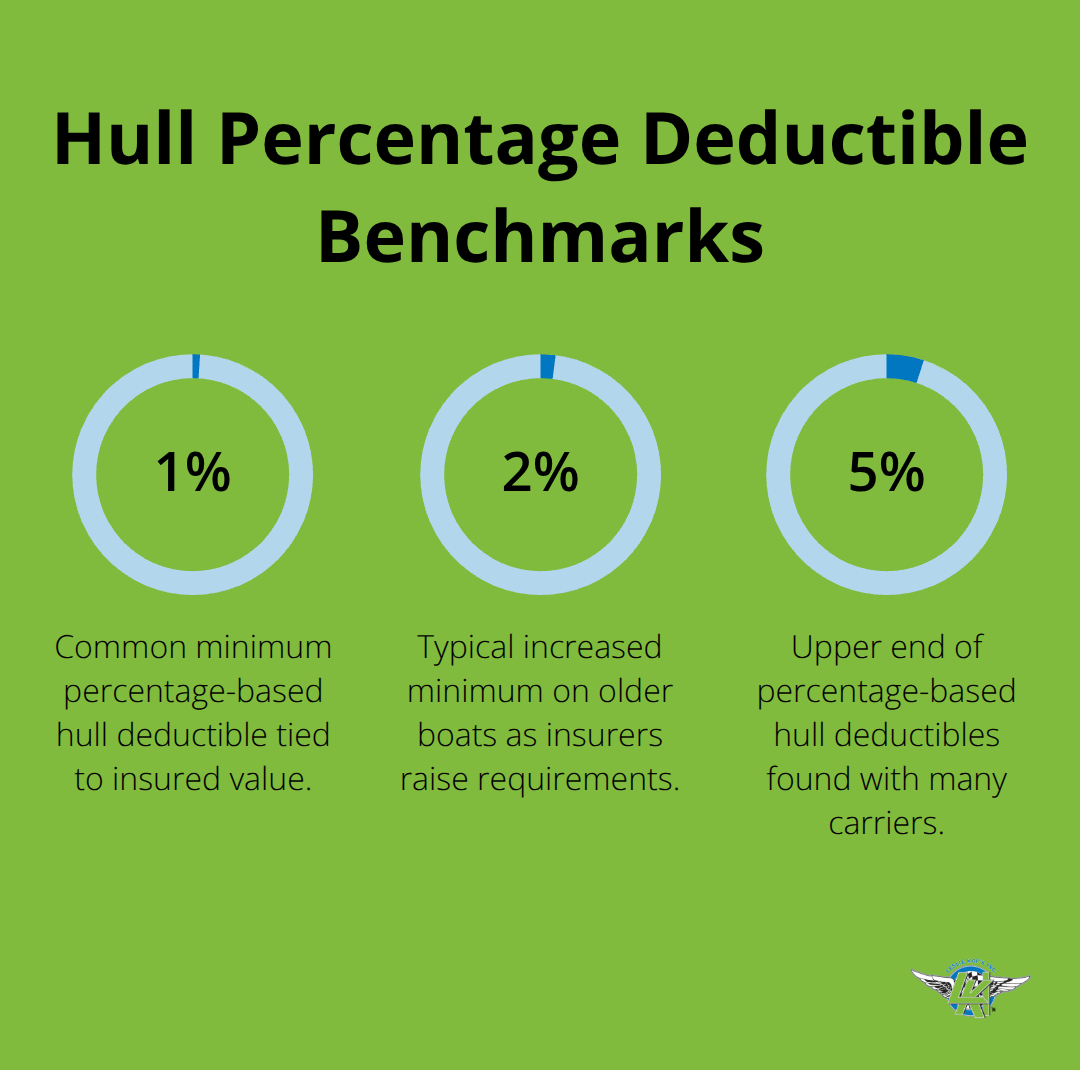
Most insurers set 1% of boat value or $250 as the minimum deductible, whichever is higher. As your boat ages, many insurers require higher minimums-jumping from $250 to $500 or from 1% to 2%. The largest premium savings occur when moving from the $250 to $500 deductible level, making this the sweet spot for cost-conscious boat owners. Trailers, tenders, and personal effects carry separate deductibles (typically $100 to $500) that cannot be adjusted and don’t follow the hull deductible structure.
How Deductible Strategy Impacts Your Budget
Raising your deductible directly lowers your annual premiums, but the savings vary by insurer and boat profile. A boat owner with a $40,000 vessel might save $100 to $300 annually when moving from a $250 to $500 deductible, depending on the carrier and coverage selected. Since total losses bypass the deductible entirely, you face higher out-of-pocket costs only on partial losses-which occur less frequently than full claims. Named Storm Deductibles in hurricane-prone areas operate separately and can reach 5% of hull value or higher in high-risk zones, significantly affecting your worst-case scenario. You should calculate your tolerance for out-of-pocket costs after a partial loss, then match it against the annual premium savings available at each deductible level.
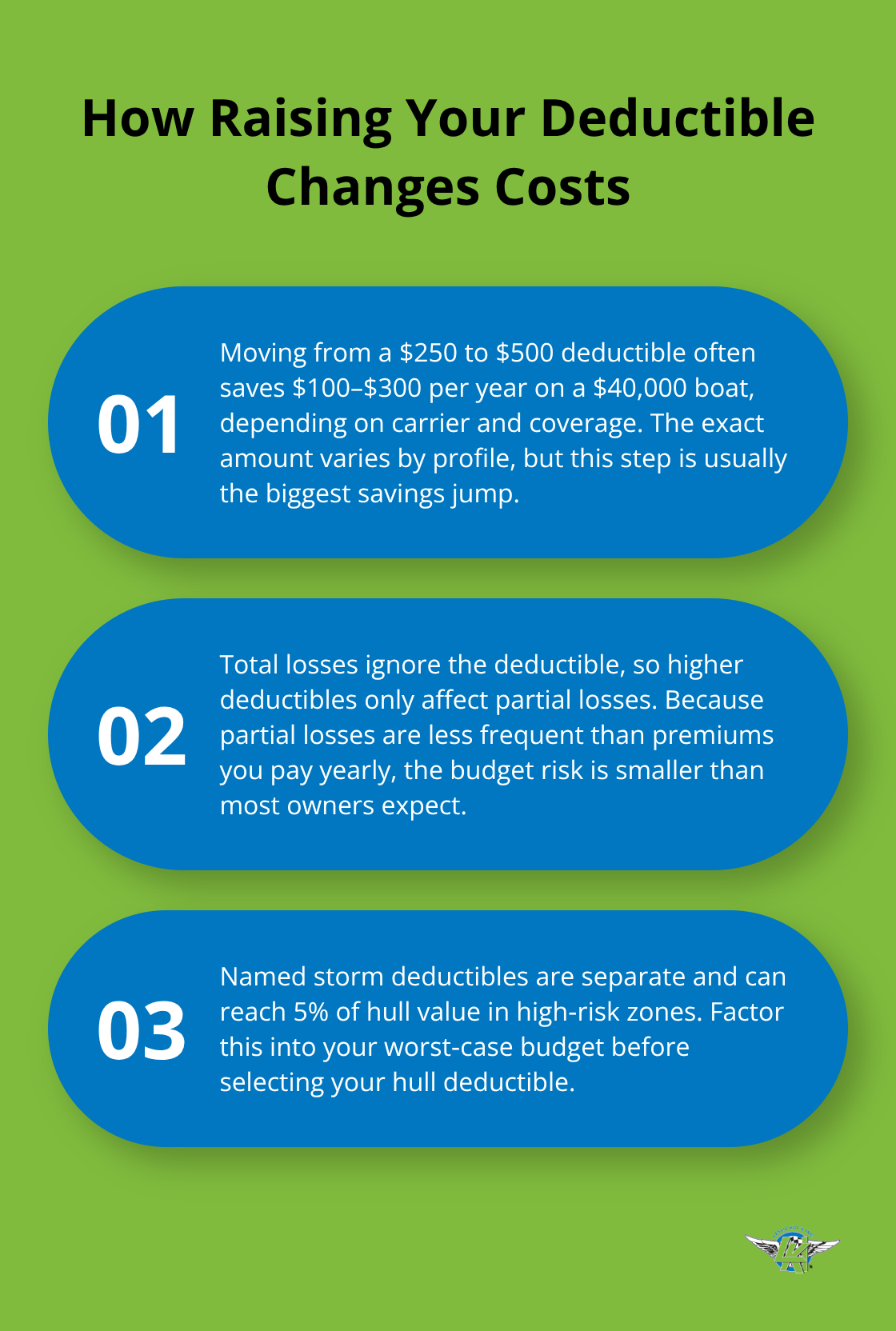
This straightforward calculation ensures your deductible aligns with both your finances and your boat’s risk profile.
Deductible Choices Across Different Coverage Types
Your hull deductible represents only one piece of your overall protection strategy. Electronics deductibles exist as a separate option on many policies, and some programs lower electronics deductibles or include them through endorsement, which affects premiums depending on your equipment value. Tender coverage can be automatic or scheduled; scheduling a tender often allows a lower deductible for the tender at an additional premium, with typical tender deductibles around $100 to $500. PWCs are often excluded as tenders on some policies, so you should verify whether your tender coverage includes personal watercraft or requires separate terms. Understanding how each deductible type works helps you avoid surprises when you file a claim and ensures you’ve selected the right protection for your specific boating situation.
How Your Deductible Choice Shapes Your Annual Cost
The relationship between deductibles and premiums is straightforward: higher deductibles lower what you pay each year, and lower deductibles raise it. Most boat owners underestimate how much they can save by moving up from the minimum $250 deductible. The largest premium reduction typically happens between $250 and $500, making this the most cost-effective adjustment for most boat owners. A $40,000 boat insured with a $250 deductible might cost $600 annually, while the same coverage with a $500 deductible could drop to $500-saving you $100 per year with minimal additional risk since total losses ignore the deductible entirely. Some insurers reward even larger increases, with savings when raising your deductible from $250 to $1,000. The exact savings depend on your boat type, age, location, and claims history, but the pattern holds across carriers: every deductible increase reduces your premium. Named Storm Deductibles in hurricane zones complicate this equation, since they apply to weather losses and can reach 5% of hull value in high-risk areas like Florida or Louisiana. A $100,000 boat with a 5% named storm deductible means $5,000 out of pocket after a hurricane claim, which many boat owners find unacceptable and choose lower storm deductibles despite higher premiums.
Why Lower Deductibles Cost You More Over Time
A $250 deductible feels safer because you pay less out of pocket per claim, but you overpay annually for protection you rarely need. Partial losses-the only scenario where your deductible matters-occur infrequently compared to the steady premium payments you make year after year. A boat owner who pays an extra $100 annually to keep a $250 deductible instead of $500 spends $1,000 over a decade for the privilege of paying $250 less on a partial loss that may never happen. The math strongly favors higher deductibles unless you regularly file claims or operate in extreme conditions. Lay-up discounts available during off-season months provide another angle for premium reduction that many owners overlook, often yielding 10% to 25% savings when your boat sits idle for three to six months. Bundling your boat policy with auto, home, or RV coverage through the same carrier typically generates 5% to 10% additional savings, making it worth shopping for multi-policy discounts before finalizing your boat insurance.
Align Your Deductible With Your Actual Boating Habits
Your deductible choice should reflect how you actually use your boat, not worst-case scenarios you imagine. Weekend pleasure boaters operating calm inland waters face far lower collision and weather risk than coastal operators navigating during storm season, yet both often select identical deductibles. A boat stored on a trailer nine months yearly and used only in calm lakes justifies a $1,000 deductible because the risk profile is minimal and premiums drop significantly. Conversely, a boat operating year-round in hurricane-prone waters might warrant a lower hull deductible paired with a named storm deductible that’s manageable-perhaps 2% instead of 5%-even if annual premiums run higher. Calculate your tolerance for out-of-pocket expenses after a realistic partial loss, then work backward to find the deductible that matches your risk comfort without paying unnecessary premiums for protection you don’t need. This alignment between your actual boating profile and your deductible structure sets the foundation for smart coverage decisions that protect both your vessel and your wallet.
Lower Your Boat Insurance Costs Right Now
The most direct path to lower boat insurance premiums starts with your deductible strategy, but many boat owners leave money on the table by stopping there. A three-part approach that combines smart deductible selection with policy bundling and maintenance practices produces the strongest results. Your deductible choice remains the fastest lever you control, but the savings multiply when combined with other proven tactics. Moving from a $250 to $500 deductible typically saves $100 to $300 annually depending on your boat value and location, yet this represents only the beginning of what’s possible.
Combine Deductible Strategy With Policy Bundling
The real opportunity emerges when you examine your full insurance portfolio and recognize that bundling your boat policy with auto, home, or RV coverage generates additional savings across all policies. A boat owner bundling marine coverage with homeowners insurance might save $50 to $150 on boat premiums alone, plus another discount on the home policy itself-meaning combined savings across both policies. This compounding effect transforms what appears as modest individual savings into substantial annual reductions. Named Storm Deductibles in hurricane zones complicate this equation, requiring a separate calculation: a $100,000 boat in Florida with a 5% named storm deductible means $5,000 out of pocket after a hurricane, which justifies either accepting lower hull deductibles or purchasing coverage from carriers offering more favorable storm deductible options in high-risk regions.
Leverage Safety Credentials and Maintenance Records
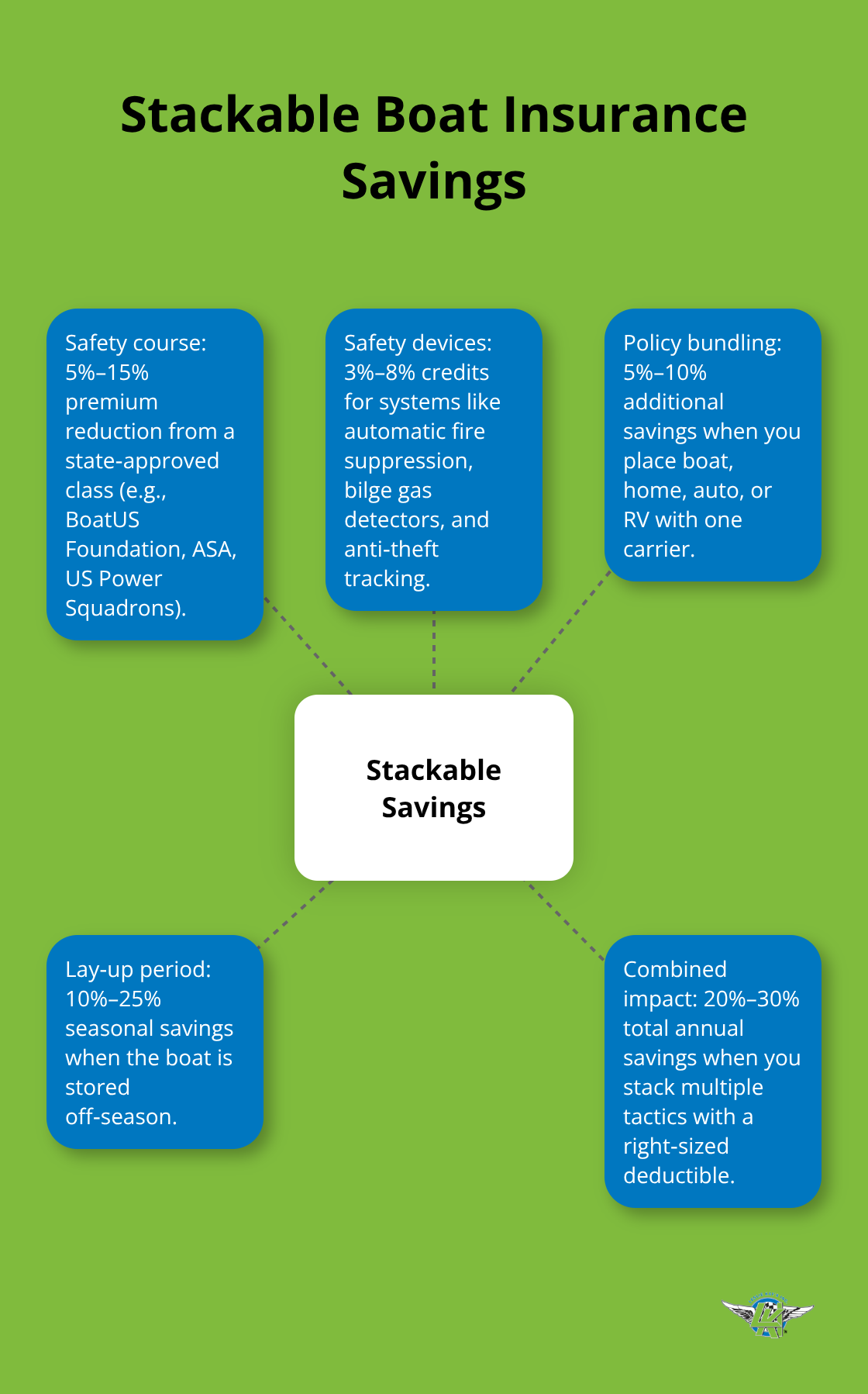
Your boat’s maintenance record and safety credentials directly influence what insurers charge, making these investments pay dividends beyond just operational safety. A state-approved boating safety course reduces premiums by 5% to 15% depending on the carrier, and courses from the BoatUS Foundation, American Sailing Association, or US Power Squadrons are widely recognized. Installing safety devices like automatic fire extinguishing systems, bilge gas detectors, and anti-theft tracking systems yields additional premium credits ranging from 3% to 8%. A boat owner combining a safety course completion with an upgraded deductible and bundled policies can realistically achieve 20% to 30% total annual savings compared to baseline coverage.
Maximize Seasonal and Loyalty Discounts
Lay-up discounts provide another underutilized opportunity: boats stored during winter months or off-season periods qualify for 10% to 25% premium reductions during those months, meaning a seasonal boat owner might pay full premium only eight months yearly and discounted rates the remaining four. Original owner status also qualifies for discounts at many carriers, rewarding stability and suggesting lower claims frequency. Progressive specifically offers disappearing deductibles where each claim-free period reduces your deductible by 25%, potentially reaching zero over time, plus small accident forgiveness that forgives claims under $500 without rate increases. This means your actual out-of-pocket cost on a small claim might be zero if you maintain clean history with the right carrier.
Stack Multiple Savings for Maximum Impact
The combination of these specific tactics-selecting a $500 deductible instead of $250, bundling policies, completing a safety course, and maintaining your boat properly-produces measurable results that far exceed what any single strategy delivers alone. A boat owner who raises the deductible, bundles with home coverage, completes a safety course, and qualifies for lay-up discounts during off-season months can reduce annual costs by 25% to 35% compared to baseline premiums. Each tactic independently saves money, but their interaction creates savings that multiply rather than simply add together. The key is treating your boat insurance not as an isolated policy but as one component of your total insurance portfolio, where strategic choices across multiple coverage types work in concert to lower what you pay.
Final Thoughts
Boat policy deductibles explained comes down to one reality: your choice directly controls both your annual premiums and what you pay out of pocket when claims happen. Higher deductibles save money year after year, especially since total losses bypass deductibles entirely, and moving from $250 to $500 typically delivers the largest premium reduction for most boat owners. Combining this deductible increase with bundled policies, safety course completion, and seasonal lay-up discounts produces cumulative savings of 25% to 35% compared to baseline coverage.
Your deductible choice matters far less than you assume because partial losses occur infrequently, meaning you pay extra premiums for years to save a few hundred dollars on a claim that may never happen. Named Storm Deductibles in hurricane zones require separate consideration, but the math still favors accepting higher deductibles unless you operate in extreme conditions year-round. Your actual boating habits-whether you’re a weekend pleasure boater or a coastal operator-should drive your deductible selection, not worst-case scenarios you imagine.
Getting your boat properly insured starts with a conversation about your actual boating habits and financial comfort with out-of-pocket costs. Request a quote and speak with our specialists about structuring your boat insurance for maximum savings without sacrificing protection. We help you find coverage that works for your boat and your wallet.
The information provided in this blog is for general informational purposes only and does not constitute legal, financial, or insurance advice. Coverage options, terms, and availability may vary. Please consult with a licensed professional for advice specific to your situation.
Artificial intelligence may have been used to generate text and images in some blog articles.