
Choosing the right boat insurance deductible can save you thousands of dollars over time, but only if you understand how it works. At Leslie Kay’s, Inc., we’ve helped countless boat owners navigate this decision, and we know it’s more complex than simply picking the lowest number.
Your deductible directly impacts both your monthly premiums and what you’ll pay out of pocket when you file a claim. Getting this balance right means protecting your investment without overpaying for coverage you don’t need.
How Deductibles Work and What You’ll Actually Pay
Understanding the Basic Mechanics
A boat insurance deductible is the amount you pay out of your own pocket when you file a claim, and your insurance company covers the rest. If your boat suffers a $5,000 hull loss and you have a $500 deductible, you pay $500 and insurance covers $4,500. The higher your deductible, the lower your annual premium because the insurance company takes on less financial risk. This relationship is direct and measurable.
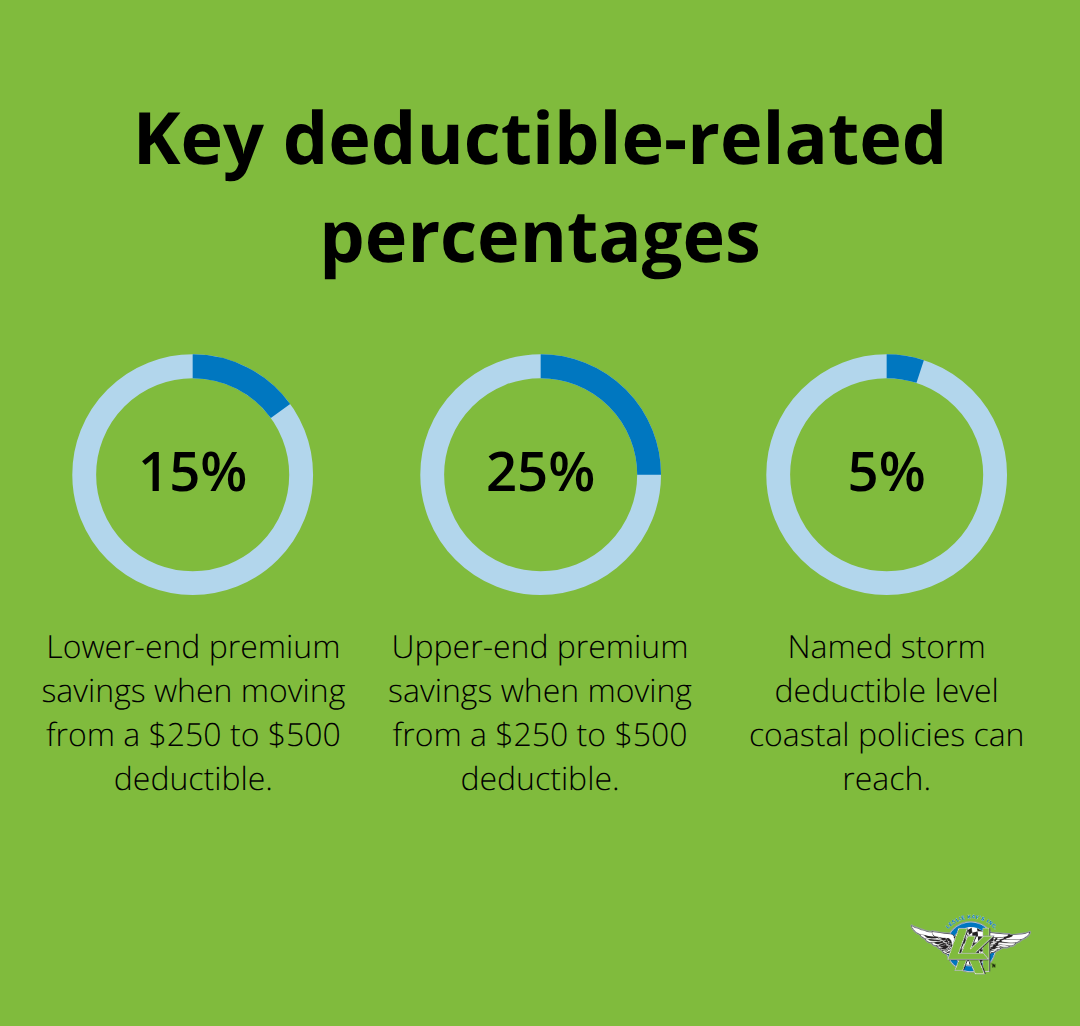
A $40,000 boat with a $250 deductible typically costs around $600 annually, while the same boat with a $500 deductible drops to approximately $500 per year-saving you about $100. Jumping from a $250 to $500 deductible typically cuts your annual cost by 15 to 25 percent, so this is the first lever to pull when you shop for better rates. The biggest premium savings for most boat owners happen at this threshold, making it worth careful consideration.
Deductible Structures and Minimums
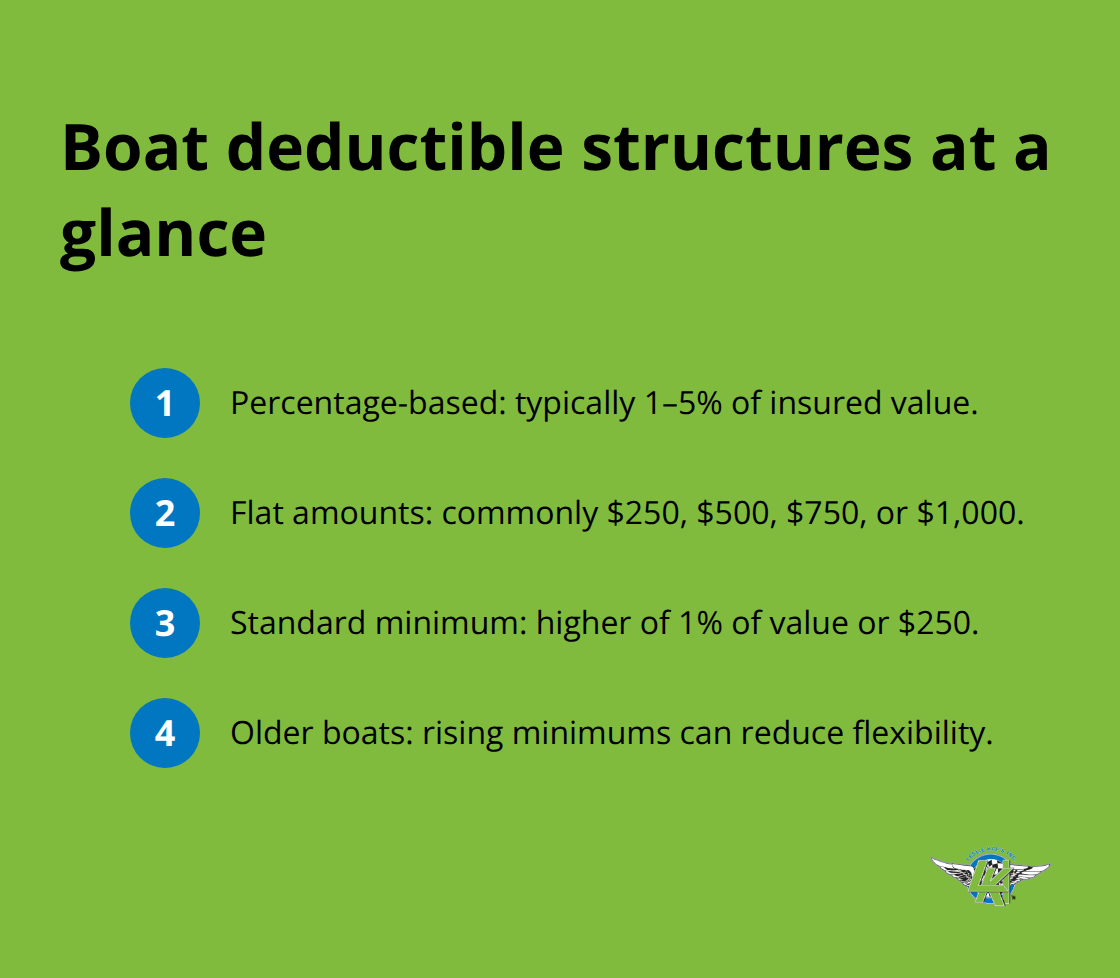
Deductibles come in two structures: percentage-based (typically 1 to 5 percent of your boat’s insured value) or flat amounts (commonly $250, $500, $750, or $1,000). Minimum deductibles often combine both-the higher of 1 percent of value or $250 is standard. As your boat ages, many carriers raise their minimum deductibles, which means older boats may have less flexibility here.
One critical detail most people miss: deductibles don’t apply to total loss claims. If your boat is destroyed, the insurance company pays the full agreed value with no deductible subtracted. Deductibles only matter for partial losses.
Special Deductibles and Hidden Costs
Beyond hull deductibles, trailers and personal effects carry separate deductibles (typically $100 to $500) that you cannot adjust. Emergency towing coverage also has its own deductible structure and annual claim limits, so you should read your policy carefully. In hurricane-prone coastal areas, named storm deductibles can reach 5 percent of hull value or higher, significantly affecting your worst-case scenario costs.
Matching Your Deductible to Your Boating Reality
The smart approach is to calculate your actual tolerance for out-of-pocket costs after a partial loss, then compare that against the annual premium savings at each deductible level. If you boat primarily on inland lakes with low accident risk, a $750 or $1,000 deductible makes financial sense. If you operate in coastal waters during storm season, a lower deductible protects you better despite higher premiums. Your deductible choice should match your actual boating patterns, not worst-case scenarios you’ll never experience.
Understanding these mechanics sets the stage for the next critical step: evaluating your personal circumstances to determine which deductible level truly works for your situation.
What Actually Matters When Setting Your Deductible
Your Boat’s Value and Age Shape Your Options
Your boat’s value and age directly determine how much financial cushion you need when something goes wrong. A $40,000 boat represents serious money, and losing $1,000 out of pocket stings differently than losing $250. If your boat is newer and financed, lenders typically require full coverage with lower deductibles anyway, so you have less flexibility. Older boats present a different calculation: as boats age, insurance companies often raise minimum deductibles, sometimes to 2 or 3 percent of insured value, which could mean $600 to $900 on a $30,000 boat. This matters because you cannot simply choose a $250 deductible on a 15-year-old vessel even if you wanted to.
The boat’s condition also affects your options-carriers may require a recent marine survey before quoting older models, and that survey can reveal maintenance issues that influence what deductibles they’ll accept.
Your Emergency Fund Is the Real Decision-Maker
Your emergency fund determines whether you can actually afford a higher deductible. Most insurers set 1% of boat value or $250 as the minimum deductible, whichever is higher. If an accident happens and you face a $750 deductible, can you pay that without derailing your finances? Many people cannot, which means they’re better off accepting a higher annual premium to protect against catastrophic out-of-pocket costs.
The math works this way: if increasing your deductible from $250 to $500 saves you $100 annually, you break even on that decision after five years of claims-free boating. But if you experience even one $3,000 partial loss in year two, suddenly that extra $500 you paid out of pocket becomes real money you didn’t have.
Where You Boat Determines Your Real Risk Level
Coastal boaters and those who operate their vessels during storm season face higher accident probability, making lower deductibles more defensible despite premium costs. Inland lake boaters with calm conditions and limited use can comfortably absorb higher deductibles because their actual risk is lower. The disconnect most owners face is treating deductible selection as theoretical rather than practical-what matters isn’t the worst-case scenario you imagine, but the actual losses you’re statistically likely to experience based on where you boat, how often you venture out, and your skill level.
This reality check leads directly to the next step: comparing actual quotes and understanding how different deductible levels translate into real savings for your specific situation.
Finding Your Actual Deductible Sweet Spot
Get Real Numbers from Multiple Insurers
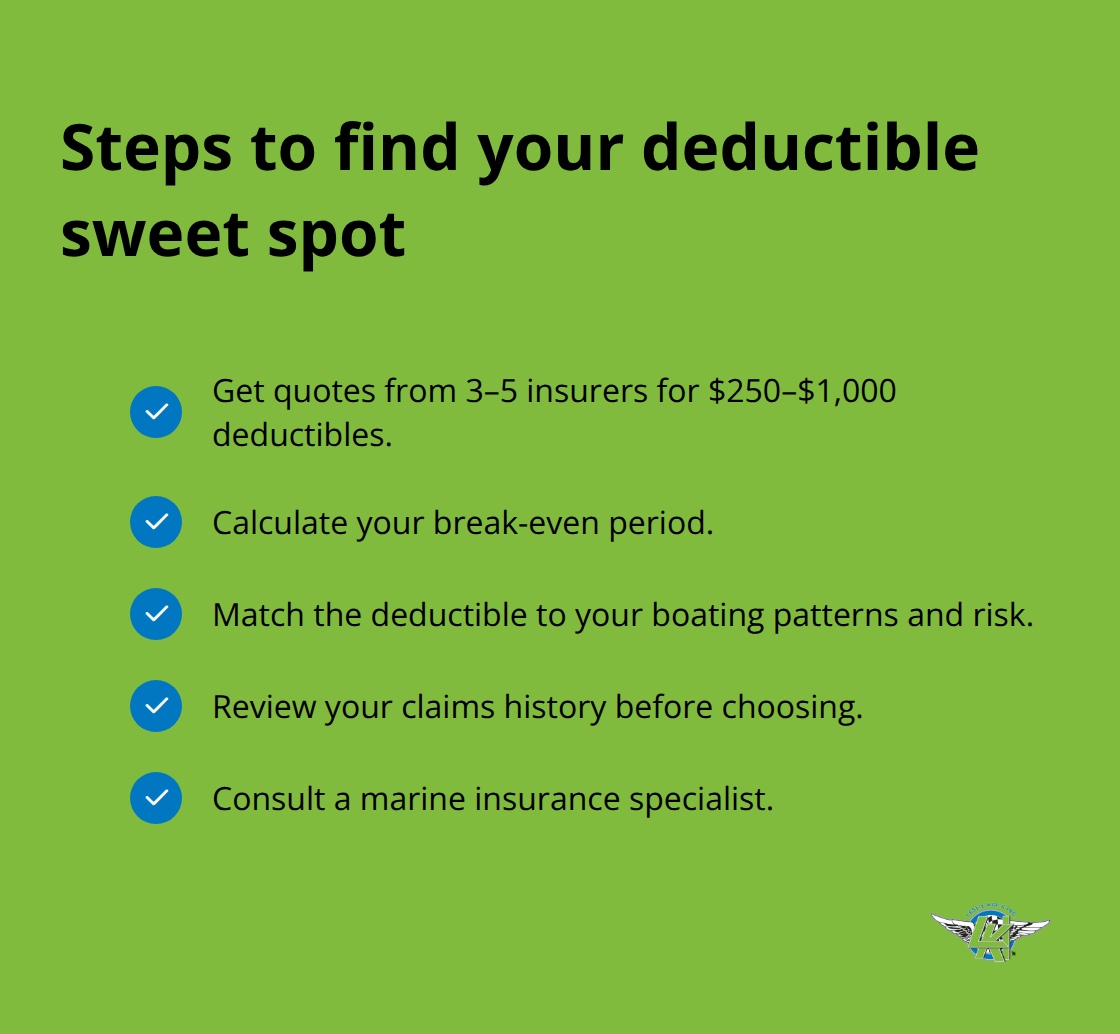
Contact three to five insurers and request quotes for your exact boat with deductibles of $250, $500, $750, and $1,000. This takes about 15 minutes per insurer online, and you’ll immediately see how the math changes for your specific situation. A $40,000 freshwater boat might show a $100 difference between $250 and $500 deductibles, but a $60,000 saltwater vessel in Florida could show $200 to $300 in annual savings.
The gap widens as boat value increases, which means high-value boats reward you more aggressively for accepting higher deductibles. Don’t rely on industry averages-your boat, location, and usage pattern create unique pricing that only actual quotes reveal.
Calculate Your Break-Even Point
Once you have three to five quotes side by side, calculate the break-even point: if switching from $250 to $500 saves $120 annually, you break even after roughly four years of claims-free boating. If you typically keep boats for seven to ten years and have a solid emergency fund, that math favors the higher deductible. If you upgrade boats every three years or your finances are tight, the lower deductible protects you better despite costing more upfront.
Match Your Deductible to Your Actual Boating Patterns
Coastal boaters and those who operate year-round should seriously reconsider deductibles above $500 because your actual loss frequency is higher-the premium savings don’t justify the risk. Inland weekend boaters with calm-water experience can comfortably move to $750 or $1,000 deductibles. Your claims history matters too: a spotless record over five years means you’re lower risk, so higher deductibles make sense; multiple small claims suggest you’d benefit from lower deductibles despite higher premiums.
Work with a Marine Insurance Specialist
An independent insurance agent who specializes in marine coverage can walk through these scenarios with your actual boat details and show you the long-term cost picture across different deductible options. Some insurers reward $750 deductibles more generously than others, and progressive disappearing deductibles that reduce your out-of-pocket amount by 25 percent after each claim-free year can shift the entire calculation. Your deductible choice shouldn’t feel like a guess-it should feel backed by actual numbers from your specific situation.
Final Thoughts
Selecting the right boat insurance deductible comes down to matching your out-of-pocket tolerance to your actual boating reality. The biggest mistake boat owners make is treating deductible selection as a one-time decision rather than a calculation tied to their specific boat, location, and financial situation. A $500 deductible saves you money only if you can afford to pay it when a claim happens and if your boating patterns justify accepting that risk.
Moving from a $250 to $500 deductible typically cuts your annual premium by $100 to $150, but that savings only matters if you have an emergency fund to cover the higher out-of-pocket cost. Over a ten-year boat ownership period, you might save $1,000 to $1,500 with the higher deductible, yet one partial loss in year two could wipe out those savings instantly. Your break-even calculation should account for how long you typically keep your boat and your actual claims history, not industry averages.
Coastal boaters and year-round operators face higher accident probability, making lower deductibles more practical despite premium costs. Inland weekend boaters with calm-water experience and clean claims records can comfortably move to $750 or $1,000 deductibles. Gather three to five quotes with different deductible levels, calculate your break-even point, and honestly assess your financial cushion, then contact a marine insurance specialist who can walk through the long-term cost picture and help you make a decision backed on actual numbers rather than guesswork.
The information provided in this blog is for general informational purposes only and does not constitute legal, financial, or insurance advice. Coverage options, terms, and availability may vary. Please consult with a licensed professional for advice specific to your situation.
Artificial intelligence may have been used to generate text and images in some blog articles.