
Boat insurance protects your investment, but finding the right coverage at the right price takes work. Getting boat insurance quotes online cuts through that hassle by letting you compare multiple carriers in minutes instead of hours.
At Leslie Kay’s, Inc., we’ve seen boat owners save hundreds annually just by comparing quotes side by side. This guide walks you through the process and shows you exactly where to find real savings.
Getting Your Boat Insurance Quote Online
The online boat insurance quote process starts with your boat’s basic information. You’ll need to provide your boat type, year, make, model, length, and moorage state. Most insurers deliver quotes within 90 seconds after you submit these details. The speed matters because you can gather multiple quotes from different carriers in under ten minutes, something that would take hours through phone calls or in-person visits. When you select your boat type, accuracy matters-if your specific model doesn’t appear in the dropdown menu, choose Other and enter the correct information rather than picking a similar model that might generate an inaccurate quote. Your boating experience also affects pricing, so prepare to share whether you’re a new boater or have years of experience on the water.
What Information Shapes Your Quote
Beyond boat specifications, insurers pull data from your driving records, claims history, and credit history to calculate rates. This means your rate isn’t just about the boat itself-it’s also about your track record as a boater and driver. A credit-based insurance score derived from your credit report may influence your premium, though this won’t affect your actual credit rating. Once you receive your initial quote, you can edit coverage selections and shop again to see how different deductibles and coverage limits change your price. Online quoting systems rank highly for user experience, and quotes can be emailed to you within minutes once you’re ready to purchase. This edit-and-shop feature lets you test whether raising your deductible from $500 to $1,000 saves you meaningful money or if adding comprehensive and collision coverage justifies the cost increase.
Making Apples-to-Apples Comparisons
When you compare multiple quotes, use identical coverage levels and deductibles across carriers so you’re actually comparing the same protection. Different states have wildly different costs-annual premiums ranged from $267 in Minnesota to $839 in Florida (based on 2023-2024 data). Great Lakes states tend to cluster in the low-cost category because inland boating on smaller boats costs less to insure than coastal saltwater boating. Longer boating seasons in southern states push premiums higher due to increased exposure.
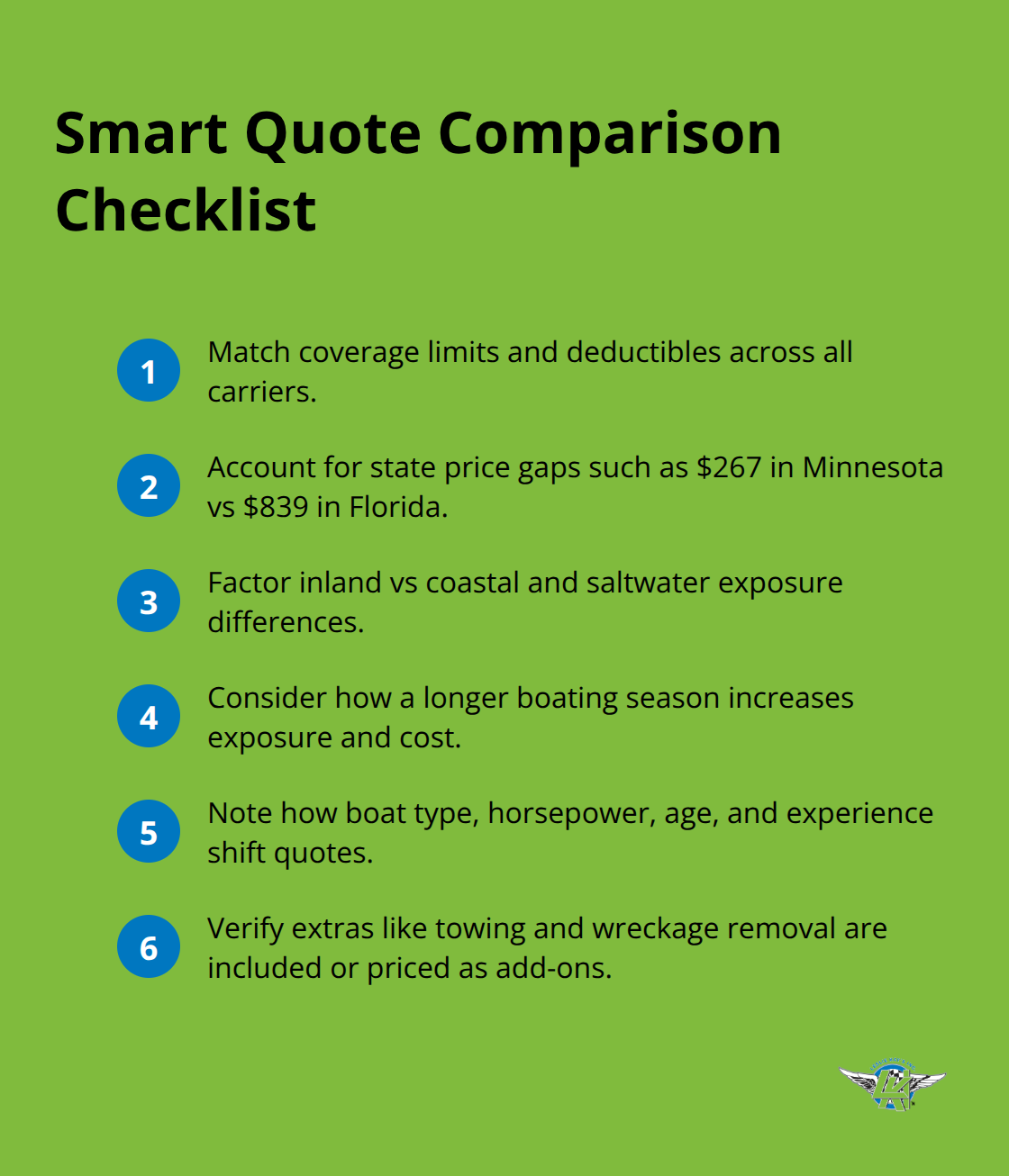
Boat type, horsepower, age, and your boating experience all influence the final number, so two quotes for the same boat in the same state might differ significantly based on engine size or your years of boating experience. Don’t assume the lowest quote is always your best option-review what each carrier actually covers, since some include towing and wreckage removal automatically while others charge extra for these protections.
Understanding Coverage Variations Across Carriers
Each carrier structures its policies differently, which means the cheapest quote might lack protections you need. Some insurers include wreckage removal and fuel spill coverage automatically, while others require you to add these as optional endorsements. Liability coverage, hull protection, and medical payments all vary in their limits and deductibles across different companies. Personal belongings coverage caps differ too-one carrier might cover fishing equipment up to $10,000 while another limits it to $5,000. Towing options also vary significantly; some carriers offer on-water towing through optional add-ons (sometimes as low as $3 per month), while others bundle it differently. The lowest price only matters if the coverage actually protects your boat and your wallet when something goes wrong.
Next Steps: From Quote to Coverage
Once you’ve gathered quotes and compared coverage options, you’re ready to move forward with selecting the right policy. The next step involves understanding how specific coverage choices affect your boat’s protection and your annual costs.
What Really Drives Your Boat Insurance Costs
Your boat’s specifications form the foundation of your premium, but the relationship between these factors and your final price isn’t always obvious. Boat type matters significantly-a 25-foot pontoon boat costs far less to insure than a high-performance center console powerboat with twin 300-horsepower engines. Horsepower directly influences rates because more powerful boats present higher risk during operation.
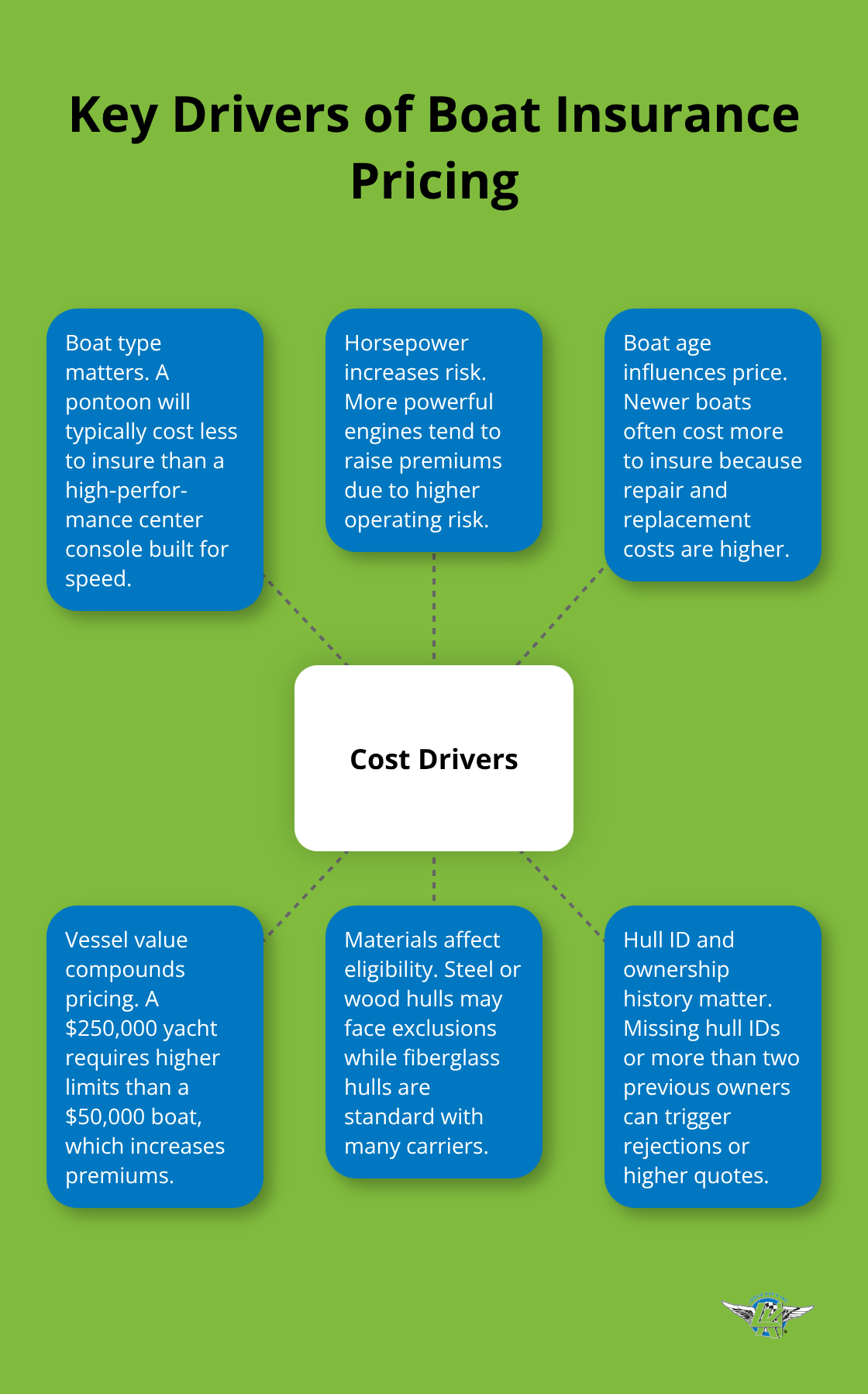
A boat’s age also shapes pricing in ways that surprise many owners: newer boats often cost more to insure than older boats because replacement and repair costs are higher. Your boat’s value compounds this effect-a $50,000 vessel requires different coverage limits than a $250,000 yacht, and insurers price accordingly. The materials matter too: steel or wood hulls face exclusions from many carriers, while fiberglass hulls are standard. Hull ID presence and ownership history affect eligibility as well-boats without hull IDs or with more than two previous owners may be rejected entirely or quoted at premium rates.
How Geography Reshapes Your Premium
Geography creates dramatic pricing swings that dwarf other variables. Progressive’s 2023-2024 data shows annual premiums ranging from $267 in Minnesota to $839 in Florida-that’s a 215% difference for comparable coverage. Low-cost states like Arkansas, Illinois, and Michigan average around $301 annually because inland boating on smaller boats dominates those regions. High-cost states including Florida, New Jersey, and Massachusetts average $657 annually due to longer boating seasons, saltwater exposure, and higher replacement costs. Where you store your boat matters as much as where you use it-boats stored in hurricane-prone areas face steeper rates than those in protected inland marinas.
Your Experience and Claims History Shape Rates
Your boating experience directly impacts pricing because inexperienced operators represent higher claims risk. New boaters typically pay more than those with years of experience on the water. Your claims history carries enormous weight-a previous boating incident or multiple property claims will increase your rate significantly. Driver history factors in too since insurers review your motor vehicle record as part of the quote process.
How Safety Courses and Credit Affect Your Price
Completing an approved boating safety course through organizations like BoatUS Foundation, the American Sailing Association, or U.S. Power Squadrons can lower your premium because these courses demonstrate responsibility. Some states offer bigger discounts for safety certification than others, so ask about this specifically when comparing quotes. Your credit-based insurance score influences pricing as well, though it won’t damage your actual credit rating.
The Interaction of Multiple Rate Factors
All these elements interact in ways that create substantial price differences. A new 30-foot sportfish boat with a powerful engine in Florida will quote dramatically higher than a 20-year-old 18-foot fishing boat in Minnesota, even if both are in good condition. Understanding which factors carry the most weight in your specific situation helps you identify where you can reduce costs-whether that means taking a safety course, improving your claims history, or adjusting your coverage selections to match your actual boating patterns and risk tolerance.
How to Cut Your Boat Insurance Costs Without Sacrificing Protection
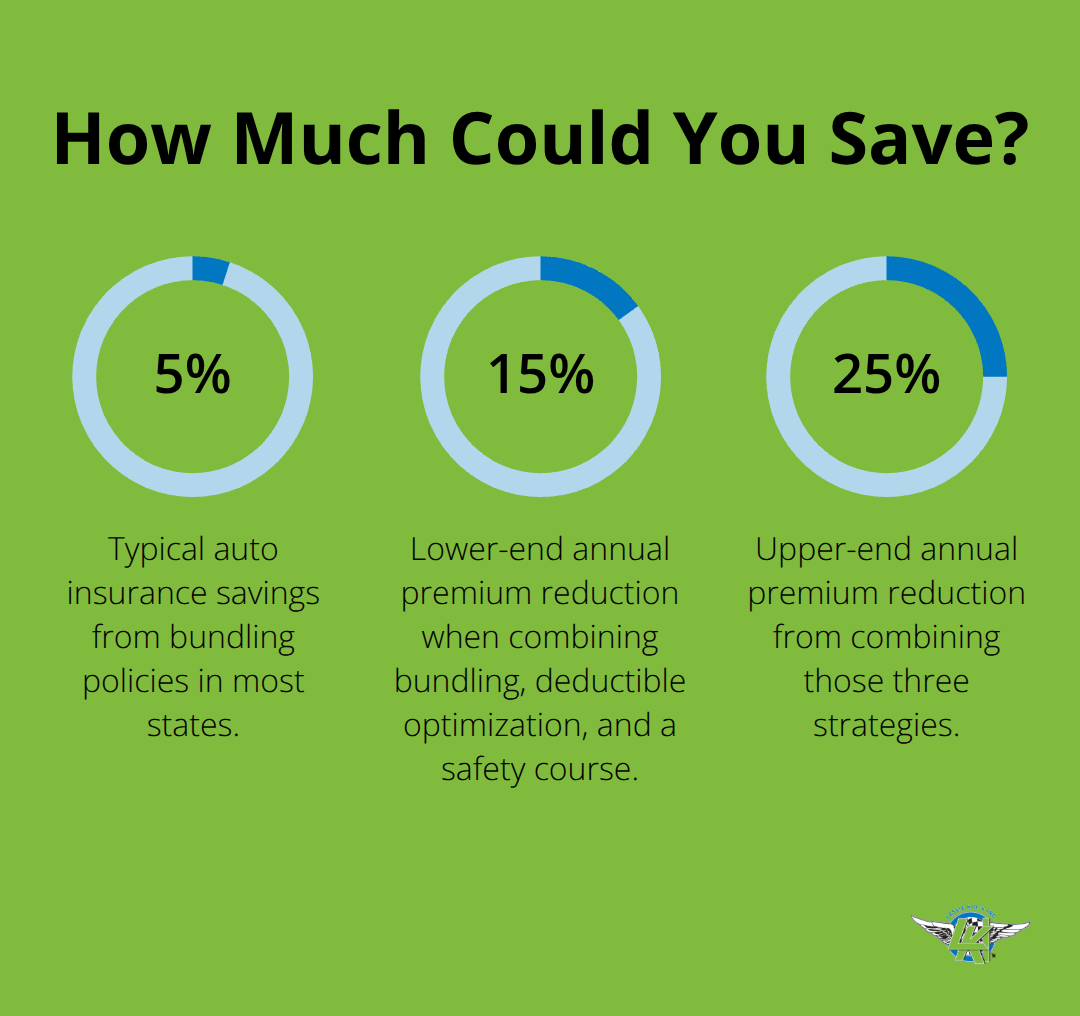
Reducing your boat insurance premium requires strategic choices, not just accepting the first quote that arrives. The three most effective cost-cutting approaches work because they directly address what insurers charge for: your risk profile, your financial responsibility if something goes wrong, and your demonstrated commitment to safe boating. Bundling your boat policy with auto, home, or RV coverage typically saves around 5% on your auto insurance in most states, though the exact discount varies by carrier and state. This matters because bundling isn’t just about convenience-it’s a negotiating tool that insurers use to reward customer loyalty and reduce their administrative costs.
Bundle Policies to Unlock Multi-Vehicle Discounts
When you shop for boat insurance quotes, ask each carrier what bundling discounts they offer before you finalize your comparison. Some carriers heavily discount bundled policies while others offer minimal savings, so the cheapest standalone boat quote might become the most expensive option once you factor in your complete insurance picture. The savings compound across your entire policy portfolio, which means a carrier offering modest boat discounts but strong auto bundling might outperform a competitor with better standalone boat rates.
Raise Your Deductible to Lower Premiums
Increasing your deductible from $500 to $1,000 or $2,500 typically lowers your annual premium meaningfully, though the exact savings depend on your boat type, location, and claims history. Raising your deductible may reduce premiums by 10 to 20 percent. However, only raise your deductible if you can actually afford to pay that amount out of pocket if your boat gets damaged. A $1,000 deductible savings means nothing if you’d struggle to cover that cost after a collision. Test different deductible levels when you’re comparing quotes to see where your personal financial situation meets the premium reduction sweet spot.
Earn Safety Course Discounts That Actually Matter
Organizations like BoatUS Foundation, the American Sailing Association, U.S. Power Squadrons, and U.S. Coast Guard Auxiliary all offer recognized courses that insurers reward with discounts. The discount amount varies significantly by state and carrier-some states offer substantial reductions for safety certification while others provide minimal savings-so ask about this specific benefit when gathering quotes. These courses typically take four to eight hours to complete and cover navigation, weather awareness, equipment operation, and emergency procedures that actually matter when you’re on the water. Beyond the insurance discount, completing a boating safety course reduces your actual accident risk, which means the premium reduction reflects genuine risk reduction rather than just an insurance company promotion. If you’re a new boater or haven’t taken a safety course in years, prioritize this before you finalize your policy.
Combine Strategies for Maximum Savings
The combination of these three strategies-bundling policies, optimizing your deductible, and earning a safety course discount-can reduce your annual premium by 15% to 25% depending on your boat and location. Your specific savings depend on which factors carry the most weight for your boat, location, and boating profile.
Final Thoughts
Online boat insurance quotes have transformed how boat owners shop for coverage. What once required hours of phone calls and office visits now takes minutes, letting you compare real quotes from multiple carriers without leaving your home. The speed alone saves time, but the real benefit comes from gathering actual pricing data that reflects your specific boat, location, and boating profile rather than relying on generic estimates.
Carriers price boat insurance differently based on their underwriting philosophy and risk tolerance. One company might charge $400 annually for your 22-foot fishing boat while another quotes $550 for identical coverage. These differences reflect how each carrier weighs factors like your boating experience, claims history, and the specific waters where you operate. Online boat insurance quotes online reveal these variations clearly and let you make an informed decision rather than accepting the first number that appears.
When you’re ready to move forward with coverage that actually protects your investment, Leslie Kay’s, Inc. specializes in watercraft coverage and works with multiple carriers to find policies that match your boat and your budget. Start comparing your boat insurance quotes online today, verify what each carrier includes versus what costs extra, and reach out when you need guidance on selecting the right protection for your watercraft.
The information provided in this blog is for general informational purposes only and does not constitute legal, financial, or insurance advice. Coverage options, terms, and availability may vary. Please consult with a licensed professional for advice specific to your situation.
Artificial intelligence may have been used to generate text and images in some blog articles.