
Riding across state lines means your motorcycle insurance needs to travel with you. Each state has different rules, minimum coverage amounts, and protection options that can leave gaps in your policy if you’re not careful.
At Leslie Kay’s, Inc., we help riders navigate multistate motorcycle insurance so you stay protected no matter where your bike takes you. This guide walks you through the regulations, coverage variations, and strategies to maintain consistent protection across borders.
Why Multistate Motorcycle Coverage Matters
State Minimums Create Real Coverage Gaps
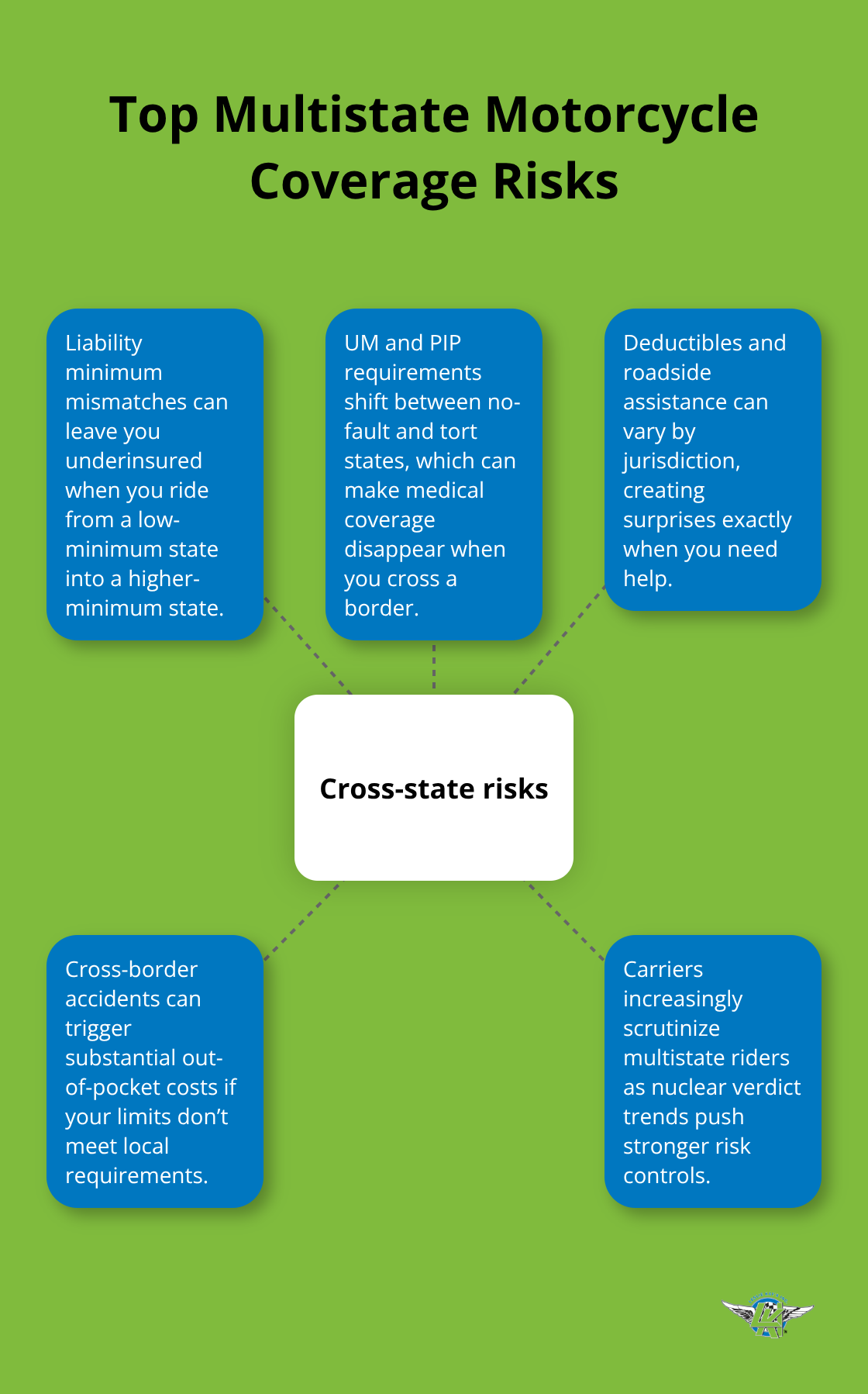
Crossing state lines with your motorcycle exposes a hard reality: the coverage that protects you in one state may not fully protect you in another. State minimum liability requirements vary significantly across states. If you ride from a low-minimum state into a high-minimum state and cause an accident, your policy might not meet that state’s legal requirement, leaving you personally liable for the difference.
Uninsured Motorist and Medical Coverage Shifts
Uninsured motorist coverage, which shields you when hit by someone without insurance, is mandatory in some states and optional in others-a gap that could cost you thousands in medical bills and bike repairs. Personal Injury Protection requirements also shift dramatically across state lines; no-fault states like Michigan require it, while tort states do not, meaning your medical coverage could vanish the moment you cross a border. The risk intensifies if you keep motorcycles in multiple states or regularly commute across borders for work.
Hidden Deductible and Service Variations
Without proper multistate planning, you might discover mid-trip that your collision coverage has a lower deductible in one state than another, or that roadside assistance doesn’t apply where you need it most. These inconsistencies create blind spots in your protection exactly when you need it.
The Financial Reality of Cross-State Accidents
The financial stakes are substantial. A single accident across state lines could expose you to catastrophic liability far beyond your policy limits. Mapping your coverage against each state’s specific minimums before you ride is non-negotiable, not optional.
Building One Comprehensive Policy
The solution isn’t buying separate policies for each state unless you keep bikes permanently in multiple locations; instead, it’s working with an agency that understands how to structure one comprehensive policy with the right endorsements and limits to cover your actual riding patterns and the varying requirements you’ll encounter. This approach keeps your protection consistent while maintaining compliance across every jurisdiction you visit. Understanding how to align your policy with state-specific regulations sets the foundation for the next step: learning exactly which regulations affect your coverage most.
How State Regulations Shape Your Coverage
Liability Minimums Create Dangerous Gaps
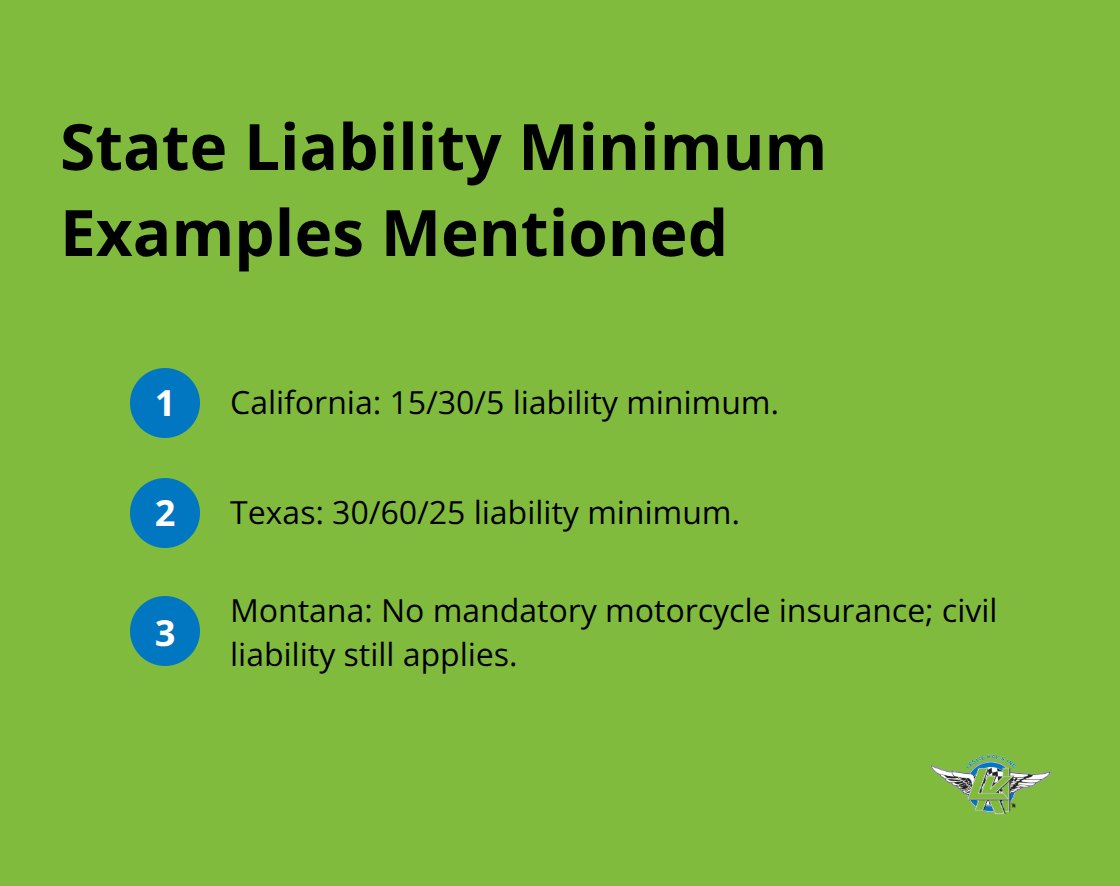
Liability minimums hit hardest when you cross state lines. California requires 15/30/5 (15,000 bodily injury per person, 30,000 per accident, 5,000 property damage), while Texas mandates 30/60/25. Ride from California into Texas after an accident and you’re underinsured by thousands. Montana has no mandatory motorcycle insurance at all, yet riders there still face civil liability if they cause damage.
Nuclear verdicts remain on an upward trajectory, posing a danger to the economy and pushing underwriters to demand stronger risk controls and data-driven assessments across state lines. This trend pushes carriers to scrutinize multistate riders more carefully.
Uninsured Motorist and Medical Coverage Splits
Uninsured motorist coverage creates equally sharp divisions between states. Michigan, a no-fault state, requires Personal Injury Protection that covers your medical bills regardless of who caused the accident. Cross into Ohio, a tort state, and PIP vanishes unless you specifically carry it. The financial impact is real: if an uninsured rider hits you in a state where UM coverage is optional and you haven’t purchased it, you absorb all medical costs and bike damage personally. Some states like Florida combine UM with underinsured motorist coverage into one requirement, while others split them entirely.
Deductibles and Service Coverage Variations
Collision and comprehensive coverages vary too, though less dramatically. Most states don’t legally require them, but lenders almost universally do if you financed your bike. The real trap emerges when your deductible structure differs across states or when roadside assistance applies in some jurisdictions but not others. One rider might face a 500 dollar deductible in their home state but discover a 1,000 dollar deductible applies when they cross into another state under the same policy if they haven’t properly structured their coverage.
Mapping Requirements and Structuring Protection
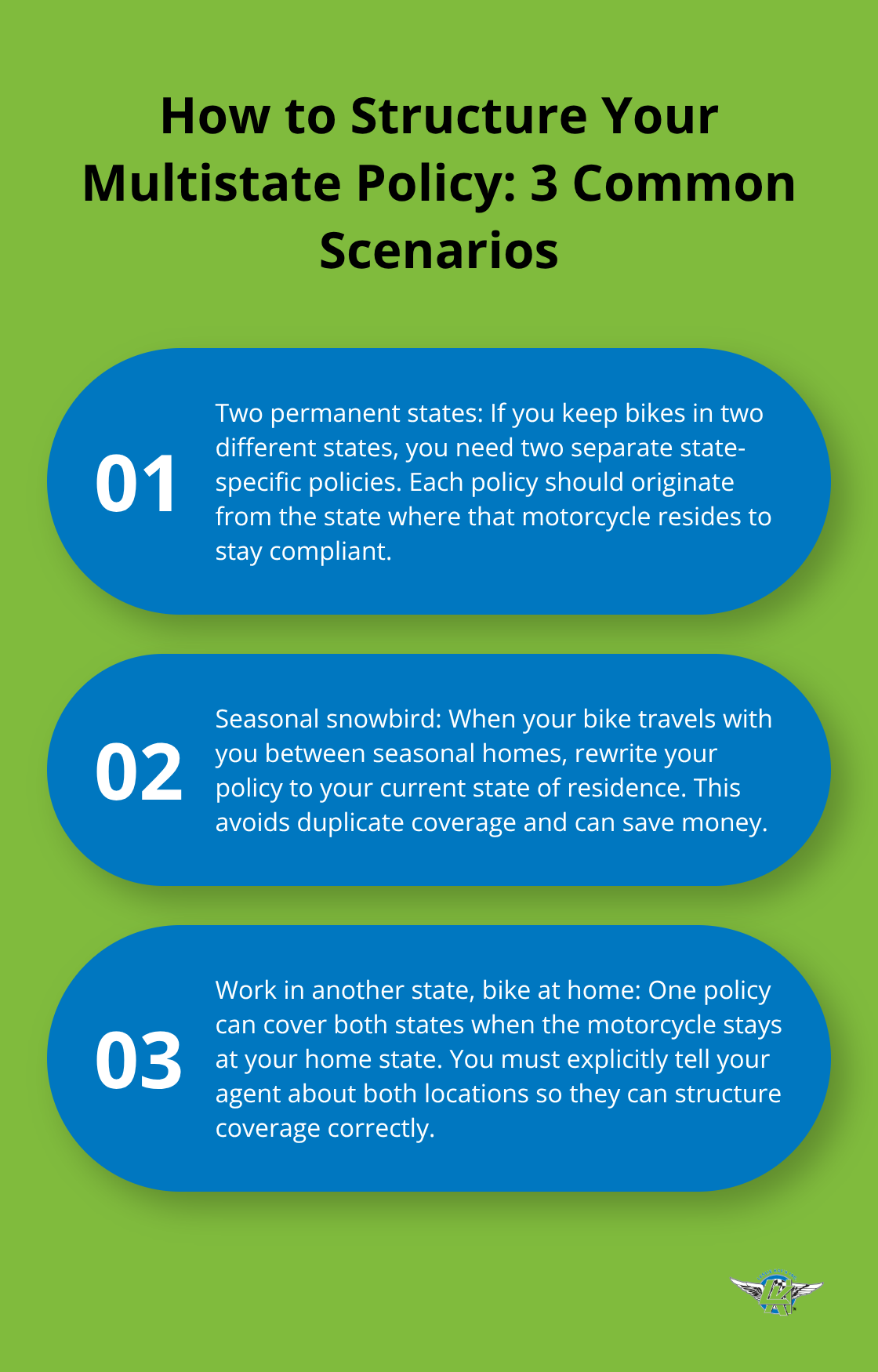
You need to map the exact minimum requirements for every state you’ll ride through, then structure your policy to meet or exceed the highest minimums you’ll encounter. This prevents you from being underinsured anywhere. If you keep motorcycles in two different states, you’ll need separate state-specific policies for each location, as one policy originates from a single state. However, if your bike travels with you between states, the snowbird strategy works: rewrite your policy to your current state of residence to avoid paying for duplicate coverage. Riders working in a different state than where they live while keeping the motorcycle at home typically need one policy covering both states rather than two separate ones. This requires explicit conversation with your agent about your actual riding patterns and work locations.
Optional Coverages That Demand Attention
Optional coverages deserve equal attention across state lines. Uninsured motorist limits should match or exceed your liability limits to maintain consistent protection across no-fault and tort states. Medical payments coverage, which pays regardless of fault, becomes more valuable the more states you cross since accident liability determinations vary widely. Roadside assistance applies inconsistently across state lines, so confirm whether your policy includes it in every jurisdiction. The key is treating your multistate coverage not as one standard policy but as a deliberately engineered protection structure that anticipates the regulatory differences you’ll face. Understanding these variations sets the stage for the next critical step: working with an agency that knows how to translate these regulations into actual coverage that protects you.
How to Structure Your Multistate Policy the Right Way
Start with Your Actual Riding Patterns
The moment you decide to ride across state lines, you need an agency that treats multistate motorcycle coverage as a specialized problem, not a standard policy adjustment. Most general insurance agents handle multistate coverage reactively-they add coverage when you ask-rather than proactively mapping your actual riding patterns against regulatory requirements. This approach leaves gaps.
The first conversation should focus on three concrete details: which states you’ll ride in most frequently, whether you keep motorcycles in multiple locations, and whether your work or residence crosses state lines. This information determines your policy structure entirely.
Match Your Policy to Your Bike’s Location
If you keep bikes in two different states permanently, you need two separate state-specific policies, one originating from each state where the motorcycle resides. If your bike travels with you between states seasonally-like moving between a winter home and summer home-the snowbird strategy saves money: you rewrite your policy to your current state of residence rather than maintaining duplicate coverage.
This requires contacting your agent to officially shift your policy’s origin state. If you work in a different state than where you live and keep your motorcycle at your home state, one policy covering both states works, but you must explicitly tell your agent about both locations so they can structure the coverage correctly.
Compare Limits Against Every State You’ll Visit
Your policy review should focus on specific limits and deductibles, not generic coverage names. Pull your current policy and compare your liability limits against the maximum requirement across every state you ride through. If you’re crossing from a 15/30/5 state into a 30/60/25 state, your policy needs to meet 30/60/25 everywhere.
The same logic applies to uninsured motorist coverage-your UM limits should match or exceed your liability limits to maintain consistent protection across no-fault and tort states. Deductibles create hidden traps that most riders miss. Ask your agent explicitly: does your collision deductible remain the same in every state, or does it vary? Does your roadside assistance apply in all states where you ride, or only in your home state? These inconsistencies matter most when you’re stranded 300 miles from home.
Use Endorsements to Close Coverage Gaps
Endorsements fill specific gaps that state regulations create. If you ride regularly into no-fault states like Michigan, your medical payments or personal injury protection needs to be adequate for both you and any passengers, since medical bills don’t wait for fault determinations. Some carriers offer optional UM stacking, which increases your uninsured motorist coverage by combining limits across multiple vehicles-valuable if you own multiple motorcycles or ride borrowed bikes.
Request a side-by-side comparison from your agent showing how your current policy performs in each state you plan to visit. This document becomes your coverage map. It should show your liability limits, UM limits, medical coverage, collision deductible, and any optional coverages you carry, plus a note indicating whether each component meets that state’s minimum requirements or exceeds them. If gaps appear, your agent should propose specific endorsements or limit increases to close them before you ride, not after an accident exposes the problem.
Final Thoughts
Multistate motorcycle insurance protects you financially when accidents happen far from home, and the regulations you’ve learned throughout this guide exist for exactly that reason. State minimums vary dramatically, uninsured motorist coverage shifts between jurisdictions, and deductibles can surprise you mid-trip if your policy lacks deliberate structure. The financial consequences of riding underinsured across state lines are severe enough that mapping your coverage before you ride matters more than almost any other preparation decision.
Most general agents treat multistate motorcycle insurance as an afterthought-a standard policy with a note about out-of-state riding-which fails because it doesn’t account for the specific minimums in each state you visit, the medical coverage requirements that shift between no-fault and tort states, or the deductible inconsistencies that emerge when you need roadside assistance 300 miles from home. You need an agency that specializes in this coverage, understands how to structure policies across state lines, and knows which endorsements close the gaps that regulations create. We at Leslie Kay’s, Inc. approach multistate motorcycle insurance as a specialized problem requiring deliberate engineering, not a standard policy adjustment, and we shop multiple carriers to find the protection that matches your actual riding patterns and the regulatory requirements you’ll encounter.
Document your actual riding patterns-which states you visit most, whether you keep bikes in multiple locations, and whether your work or residence crosses state lines-then contact Leslie Kay’s, Inc. with that information. We’ll map your coverage against each state’s specific requirements, identify gaps, and structure your policy to close them. Your multistate motorcycle insurance should protect you consistently across every border you cross.
The information provided in this blog is for general informational purposes only and does not constitute legal, financial, or insurance advice. Coverage options, terms, and availability may vary. Please consult with a licensed professional for advice specific to your situation.
Artificial intelligence may have been used to generate text and images in some blog articles.