
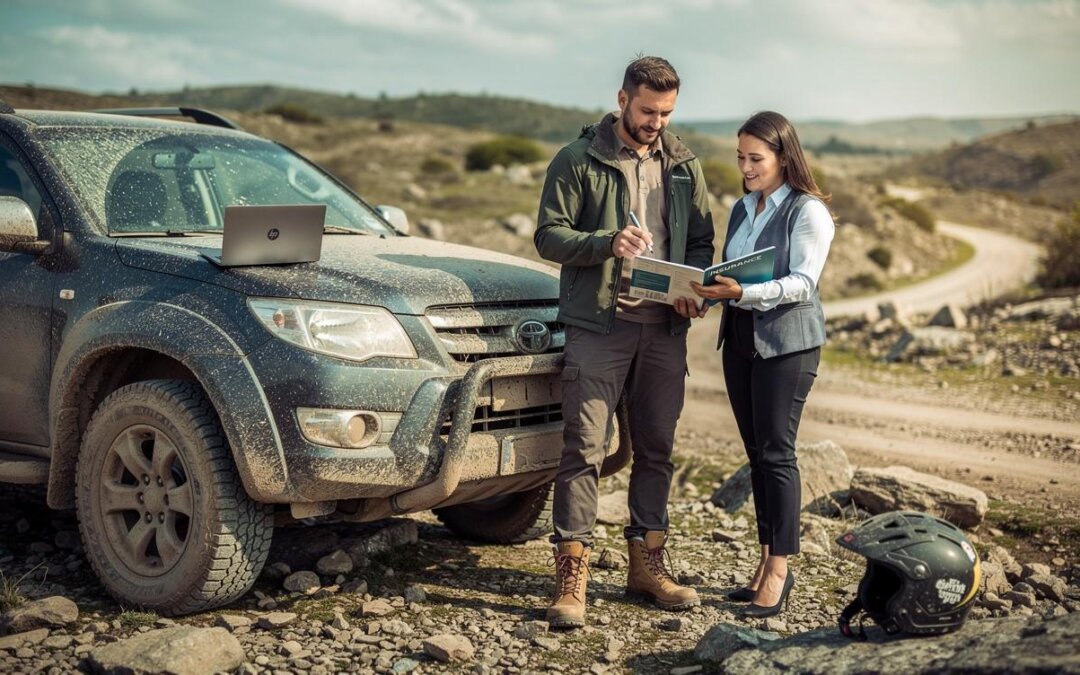
Standard auto insurance won’t cut it when you’re tackling rocky trails and remote terrain. Most policies exclude off-road activities entirely, leaving you exposed to serious financial risk.
At Leslie Kay’s, Inc., we’ve seen too many riders discover coverage gaps right when they needed protection most. This guide walks you through what an off road vehicle policy should actually cover and how to find the right fit for your adventures.
Essential Coverage Types for Off-Road Adventures
Liability Protection Stops Financial Disasters
Liability coverage handles the costs when you damage someone else’s property or injure another rider. Most states require at least bodily injury limits of $20,000 per person and $40,000 per accident, with property damage minimums around $15,000-Illinois law requirements that reflect broader industry standards. Most riders make a critical mistake here: they stick with minimum limits. On rough terrain where medical helicopters might be needed, those minimums evaporate fast. Higher limits of $100,000 per person and $300,000 per accident cost only marginally more and provide real protection against catastrophic liability claims.
Collision and Comprehensive Coverage Protects Your Machine
Collision coverage pays for repairs when you hit a tree, rock, fence, or another vehicle, regardless of fault. Comprehensive coverage protects against theft, vandalism, fire, and weather damage-critical since ATVs and UTVs are frequently stolen from truck beds or trailers. Many riders assume they need only liability, but that leaves a $25,000 UTV completely unprotected if it’s stolen or damaged.
The real decision involves deductibles and agreed value coverage. Agreed value policies pay the full insured amount on total loss, while actual cash value policies deduct depreciation. For newer machines or heavily customized builds with thousands in aftermarket parts, agreed value coverage is worth the premium increase.
Medical Payments and Accessory Coverage Fill Critical Gaps
Medical payments coverage covers medical bills for you and your passengers after an accident, regardless of who caused it. This coverage typically costs between $100 and $350 annually for full protection-a modest expense compared to emergency room visits or surgical costs that can easily reach tens of thousands of dollars.
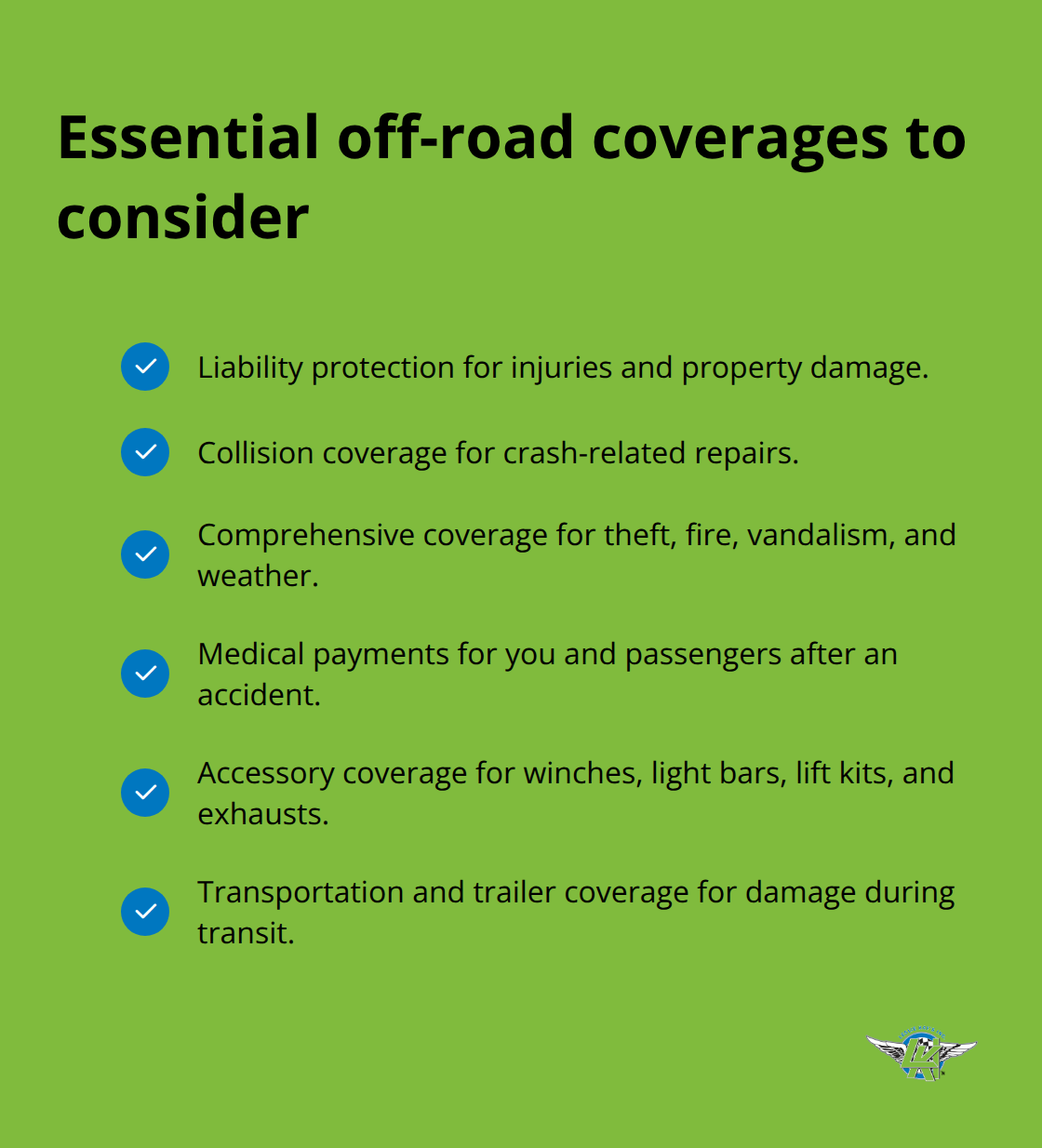
Accessory coverage deserves special attention because standard policies cap protection at $500 to $1,000 unless you add endorsements. If you’ve invested in winches, light bars, lift kits, or custom exhausts, you need explicit coverage for those parts (often available up to $2,000 with options to increase further). Transportation and trailer coverage protects your vehicle while loaded on a trailer en route to riding areas-another gap many riders overlook until damage occurs during transit.
Finding the Right Coverage Mix for Your Situation
The coverage you select depends on your vehicle’s value, the modifications you’ve made, and where you actually ride. A basic liability-only policy for an older ATV costs under $150 per year, while full coverage for a newer $25,000 UTV costs more but remains reasonable relative to replacing the machine. Specialists who understand off-road risks can help you avoid overinsuring low-value equipment while ensuring your high-value investments receive adequate protection.
Why Your Car Insurance Won’t Cover Off-Road Riding
Standard Auto Policies Exclude Off-Road Activities Entirely
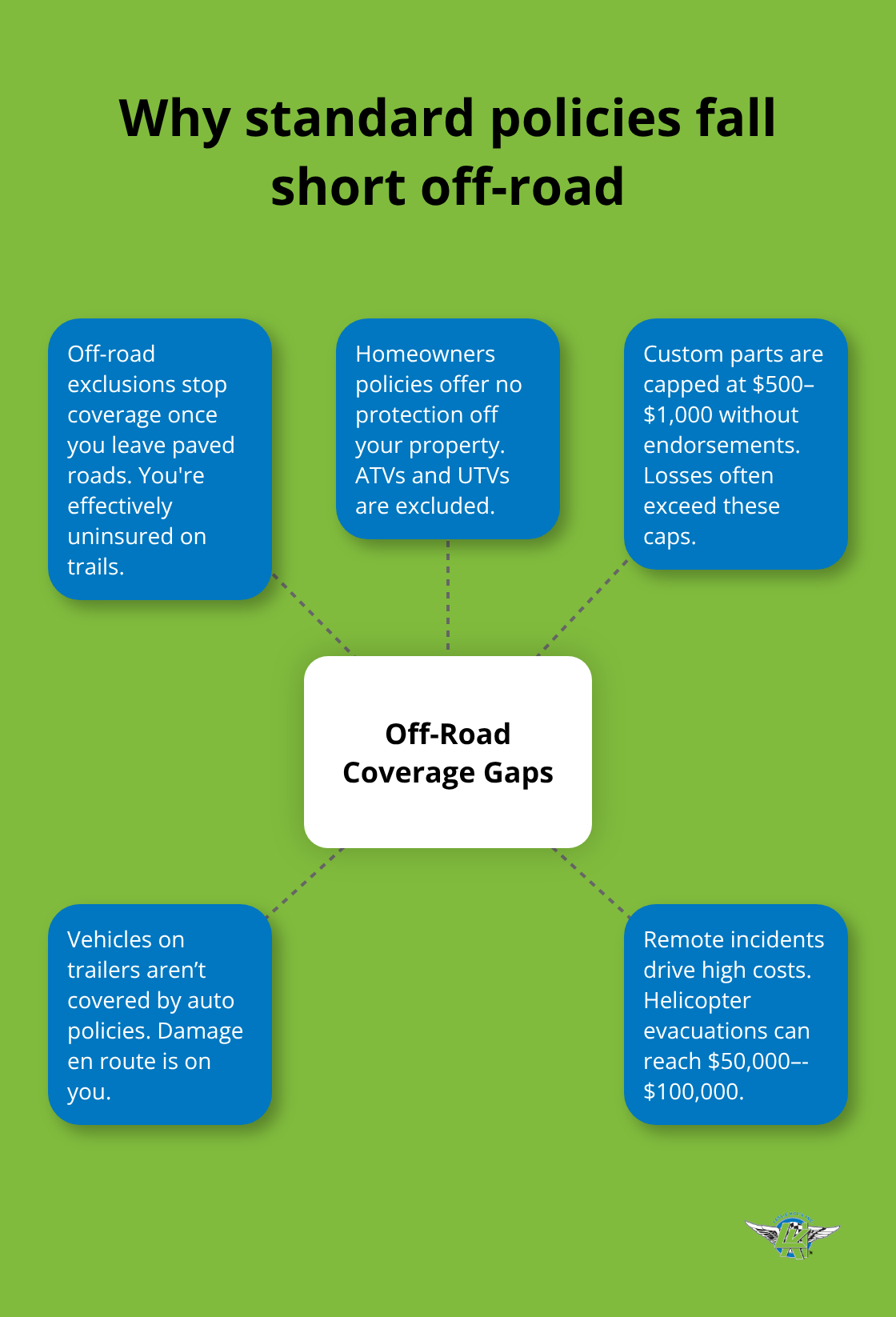
Standard auto insurance policies contain explicit exclusions that eliminate coverage the moment you leave paved roads. Insurance companies classify off-road activities as high-risk recreation outside the scope of personal auto coverage, which means you operate without any protection when you hit the trails. This gap exists because standard policies assume vehicles operate on public roads where traffic laws and predictable conditions apply. Off-road terrain introduces variables-sudden obstacles, steep grades, limited visibility, and remote locations-that traditional underwriting models don’t account for.
Homeowners Insurance Offers Zero Protection
Your homeowners policy provides even less protection than auto insurance. Most homeowners policies offer zero coverage for ATVs, UTVs, dirt bikes, or snowmobiles once they leave your property. The financial exposure becomes severe quickly. A single accident requiring a medical helicopter evacuation can generate $50,000 to $100,000 in emergency response costs alone, and liability claims from injured riders or damaged property can easily exceed your standard auto policy limits.
Custom Modifications Create Massive Coverage Holes
Custom modifications and aftermarket accessories create another massive coverage gap. If you install a winch, light bar, lift kit, skid plates, or custom exhaust, standard policies typically cap coverage at $500 to $1,000 total, regardless of actual value. A quality winch alone costs $800 to $2,500, so theft or collision damage wipes out your investment with no insurance recovery. Accessory coverage endorsements and dedicated off-road policies address these gaps explicitly, protecting custom parts up to $2,000 or higher with options to increase limits.
Transportation Coverage Protects Vehicles in Transit
Transportation coverage presents a third gap that catches many riders off guard. While your vehicle sits on a trailer en route to riding areas, standard auto policies don’t extend protection. Damage during transit-whether from road debris, improper securing, or trailer accidents-falls entirely on you. The cost difference between inadequate coverage and proper protection rarely exceeds $100 to $200 annually, yet the financial consequences of gaps can reach tens of thousands of dollars.
An independent agency like Leslie Kay’s, Inc. can help you navigate these gaps by shopping multiple carriers to find policies that address off-road risks your standard coverage ignores. The right off-road policy transforms your protection from nonexistent to comprehensive, covering the specific scenarios that standard insurance explicitly excludes.
Matching Coverage to Your Riding Reality
Assess Your Actual Riding Patterns Honestly
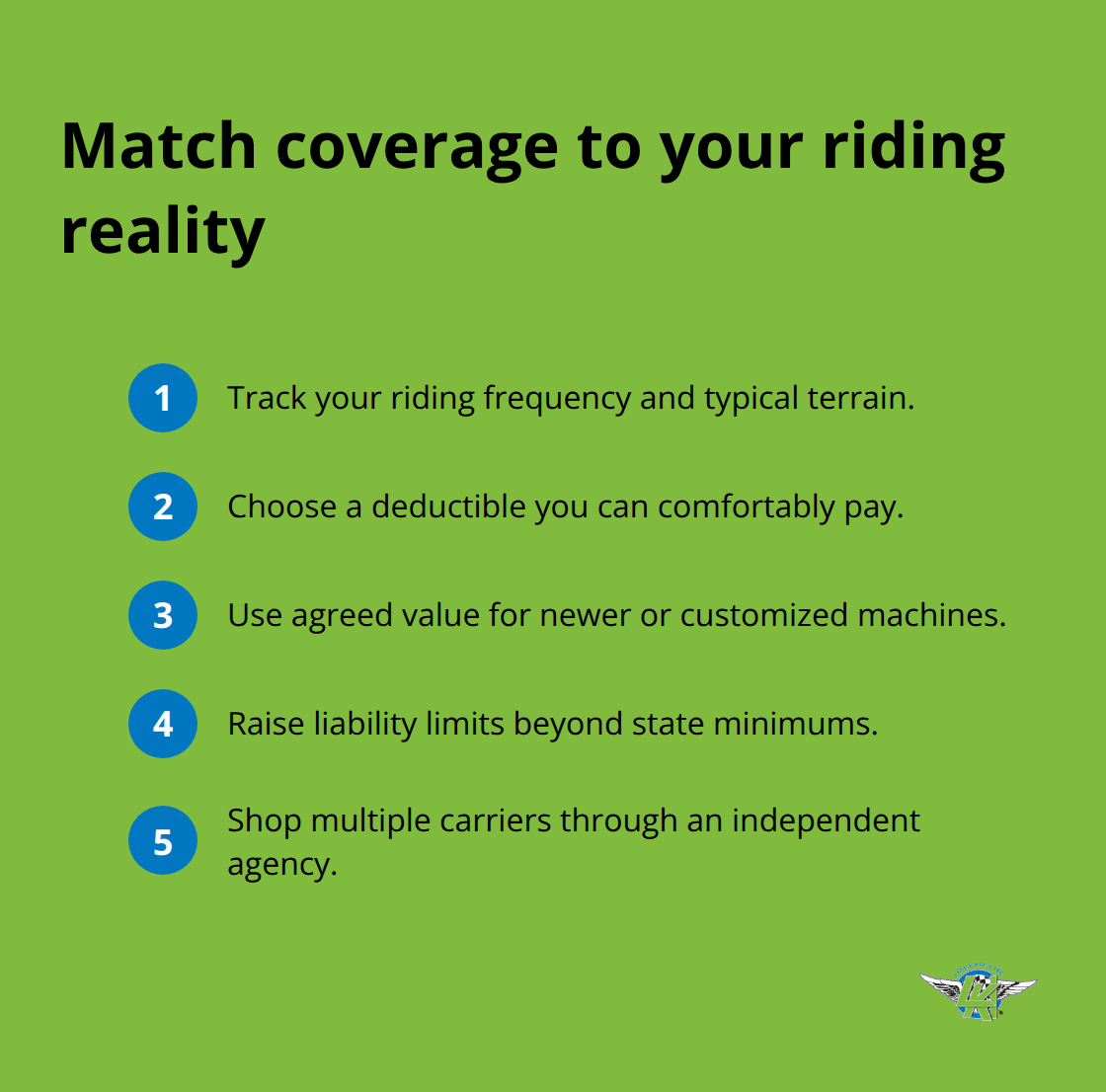
Start with brutally honest answers about how you actually ride, not how you think you should ride. Most riders overestimate their experience level and underestimate terrain difficulty, which leads to inadequate coverage choices. Track your riding for three months: How many days per month do you ride? What terrain dominates-rocky single-track, mud, sand dunes, or mixed conditions? Do you ride alone or with passengers regularly? Are you hitting state park trails or private land? Do you participate in organized events or casual weekend trips? These specifics matter because they directly affect your risk exposure and insurance costs.
A rider hitting groomed trails once monthly faces different exposure than someone tackling backcountry terrain weekly with three passengers in tow. Your deductible choice should reflect this reality too. A $500 deductible makes sense if you’re financially prepared to pay it after a collision; choosing $250 just to feel safer often backfires when that modest premium savings gets erased by one minor claim.
Select Valuation Methods That Match Your Vehicle
Agreed value coverage can objectively provide greater financial protection for vehicles exceeding $15,000 or heavily customized builds, while actual cash value works fine for basic ATVs under $8,000 where depreciation is already substantial. Agreed value policies pay the full insured amount on total loss, whereas actual cash value policies deduct depreciation. The premium difference rarely exceeds $100 to $200 annually, yet the financial protection difference proves substantial when you file a claim on a newer machine.
Raise Liability Limits Beyond State Minimums
The coverage limits you select demand equal scrutiny. Standard liability minimums of $20,000 per person and $40,000 per accident sound adequate until you calculate actual costs-a single medical helicopter evacuation runs $50,000 to $100,000, and serious injuries quickly generate six-figure medical bills. Bumping to $100,000 per person and $300,000 per accident typically costs $30 to $60 more annually, yet prevents financial catastrophe.
Protect Your Aftermarket Investments Explicitly
Accessory coverage requires specific attention to your actual investments. If you’ve installed a $1,500 winch, $800 light bar, and $600 lift kit, that’s $2,900 in aftermarket parts that standard policies cap at $500 to $1,000. Many carriers allow accessory coverage endorsements up to $2,000, and some offer higher limits for additional premium. Transportation and trailer coverage should be automatic if you haul your vehicle to riding areas, since damage during transit isn’t covered by standard policies.
Shop Multiple Carriers for Your Best Option
Independent agencies can access options that direct online carriers won’t show you, often uncovering $200 to $400 annual savings by matching your actual risk profile rather than forcing you into their standard product. Multiple carriers simultaneously provide different rate structures and coverage combinations-what works best for one rider’s profile may cost significantly more for another’s.
Final Thoughts
Standard auto insurance leaves you completely exposed when you’re riding off-road, and waiting until after an accident to discover coverage gaps costs far more than proper protection. We at Leslie Kay’s, Inc. have worked with hundreds of riders who thought their existing policies covered trail riding, only to face tens of thousands in out-of-pocket expenses after collisions, theft, or medical emergencies. An off-road vehicle policy designed specifically for your riding style eliminates this risk entirely.
The right coverage protects three critical areas that standard policies ignore: liability exposure that can reach six figures after a serious accident, damage to your vehicle from terrain hazards and theft, and medical costs for you and your passengers. Agreed value coverage ensures newer machines receive full replacement value rather than depreciated amounts, while accessory endorsements protect your winches, light bars, and lift kits up to $2,000 or higher. Transportation coverage guards your vehicle while it sits loaded on a trailer heading to riding areas, and these protections cost between $100 and $350 annually for comprehensive coverage-a modest investment compared to replacing a $25,000 UTV or paying medical bills that exceed six figures.
Your next step involves honest assessment of your actual riding patterns, vehicle value, and modifications, then shopping multiple carriers rather than accepting the first quote you receive. Different insurers rate off-road risk differently and offer varying accessory coverage limits, so contact Leslie Kay’s, Inc. to shop multiple carriers and find an off-road vehicle policy that matches your specific riding profile and budget.
The information provided in this blog is for general informational purposes only and does not constitute legal, financial, or insurance advice. Coverage options, terms, and availability may vary. Please consult with a licensed professional for advice specific to your situation.
Artificial intelligence may have been used to generate text and images in some blog articles.